Biennale Art
History
The 1970s
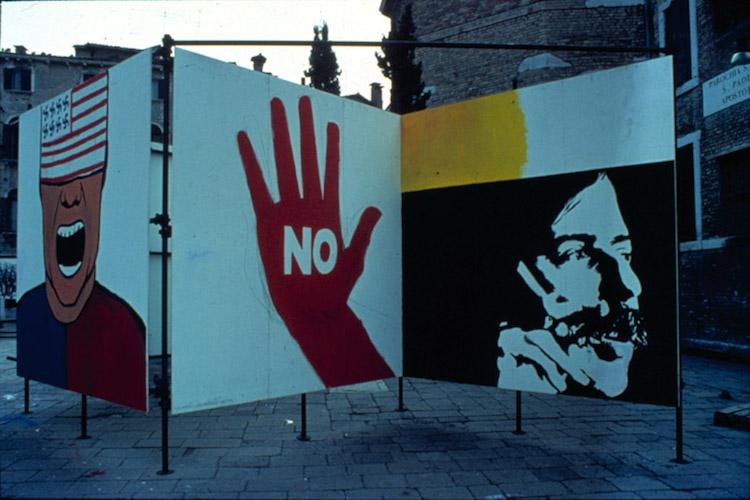
Despite of the crisis derived from the turbulent 1960s, the Biennale also took place in 1970. The protests of '68 had left their mark: the Grand Prizes came to be abolished (although taken up again in 1986 with the Golden Lion award), the sales office was also eliminated, as it was considered an instrument for the commercialisation of art. The monographical and celebratory exhibitions were temporarily given up, and instead, thematic exhibitions such as Research and Planning and Art in Society were proposed. The General Secretary Umbro Apollonio and Dietrich Mahlow curated the special exhibition Proposal for an Experimental Exhibition, the aim being to "present some problematics in the arts", lining up works by Malevich, Duchamp, Man Ray, and Albers.
In 1971 Mario Penelope was nominated Special Commissioner for Fine Arts, and immediately organised an exhibition entitled Aspects of European Graphics at Ca' Pesaro. Penelope created a much appreciated Biennale in 1972, which was articulated in a series of exhibitions. He also proposed a comprehensive theme for the first time entitled Work and Behaviour . During this Biennale, ten thousand butterflies were liberated from a large wooden chest in Saint Mark's Square. Gino De Dominicis, just twenty-five years old at the time, "exhibited" a boy affected by Down's Syndrome, hanging a sign from his neck reading "Second solution for immortality: the universe is immobile". This caused a major scandal and public protests against this "cynicism" provoked interrogations in Italian parliament.
The statute of the Venice Biennale remained a major problem to be resolved: there were many requests to up-date the Biennale as an institution. The new statute of the Biennale was approved by Italian parliament on 26th July, 1973, but it was not until 20th March, 1974, that the 18 members of the Board came to be nominated.
|
|
|
|
|
| |
|
|
| |
|
|
|