Art -
Biennale Arte 2026: In Minor Keys
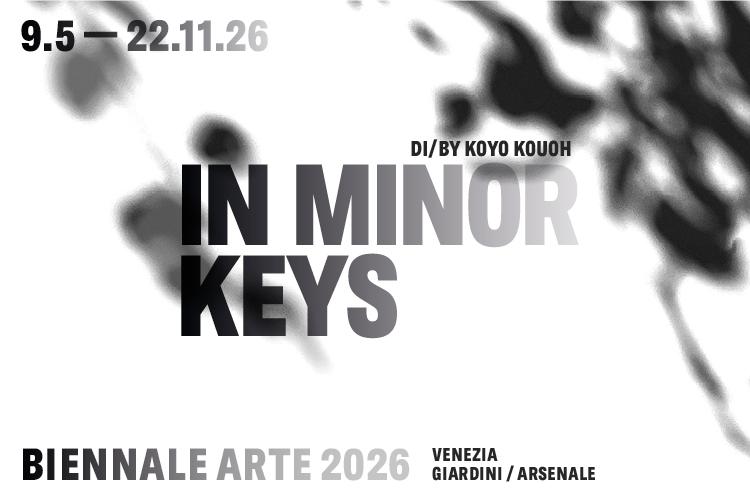
The 61st International Art Exhibition of La Biennale di Venezia, In Minor Keys by Koyo Kouoh, opens on Saturday 9 May.
Biennale Arte 2026
The 61st International Art Exhibition of La Biennale di Venezia, In Minor Keys by Koyo Kouoh, will run from Saturday 9 May to Sunday 22 November 2026 at the Giardini, the Arsenale and in various locations around Venice. The pre-opening took place on May 6, 7, and 8. The International Jury was announced in April. The Golden Lions for Lifetime Achievement will not be awarded this year, as Koyo Kouoh was unable to finalize them.
After the premature passing of Koyo Kouoh in May 2025, with the full support of her family, La Biennale di Venezia decided to carry out her Exhibition, with the purpose of preserving, enhancing and widely disseminating her ideas and the work she pursued with such dedication to the very end. Koyo Kouoh, nominated as the Artistic Director of the Visual Arts Department in November 2024, already developed the curatorial project, defining its theoretical framework, selecting the artists and the artworks, designating the authors of the catalogue, determining the graphic identity of the Exhibition and the architecture of the exhibition spaces, and establishing a dialogue with the artists invited to participate.
In Minor Keys is the title chosen by Koyo Kouoh for the 61st International Art Exhibition, as specified in the curatorial text, which was sent to the President of La Biennale on 8 April 2025. The Exhibition will be realised with the contribution of the team selected by Koyo: Gabe Beckhurst Feijoo, Marie Hélène Pereira and Rasha Salti (advisors); Siddhartha Mitter (editor-in-chief); and Rory Tsapayi (research assistant).
During the presentation in Venice, at Ca’ Giustinian, headquarters of the La Biennale di Venezia, they were the ones who outlined the work carried out together with Koyo for the 61st International Art Exhibition. This work culminated in a significant meeting held in Dakar in April 2025 at RAW Material Company — the cultural center founded by Kouoh — and led by the Curator herself. That experience remains emblematic of the way she conceived curatorial practice: grounded in relationships and open to the unexpected.
“That week in Dakar – stated Koyo’s Team - was the edifying week that defined the 61st International Art Exhibition. We mapped practices and projects, we identified resonances, affinities, synchronicities and conversations, we extracted motifs to structure the exhibition and pillars on which to draw it. Notions like enchantment, seeding, commoning, and generative practices that invite collectivities, emerged organically. On the last day of our convention, after reckoning that we had accomplished the most daunting milestone, Koyo assigned missions to each of us. The exhibition had found its manifest forms, it was no longer intention, nor abstraction. We could hear the music she so gracefully composed with us, under the generous guardianship of the mango tree.”
Koyo’s Team, with members based in different cities around the world — Gabe in London, Marie Hélène between Dakar and Berlin, Rasha between Beirut and Marseille, Rory in Cape Town, and Siddhartha in New York City — has in recent months continued the work of producing the Exhibition, engaging La Biennale in a special effort during the project’s development phase, particularly the Visual Arts Department. Remote work through online meetings, combined with in-person seminars held in Venice in May and October 2025 and in Dakar in June 2025, enabled the Team to work alongside the Biennale while being distributed across several continents. This gave rise to an intense, multilayered, and deeply shared process, in which each contribution enriched the collective construction of the Exhibition.
A comment from
Pietrangelo Buttafuoco
“The joy of authentic art, which so faithfully resembles real life” – the President of La Biennale di Venezia Pietrangelo Buttafuoco commented. “The pages of In Minor Keys, which Koyo sent to La Biennale almost a year ago, offer a striking insight into her curatorial practice and spell out a crystal-clear notion of her own concept of an exhibition. Koyo presents us with this concept through the very idea of sowing seeds, and it is through her teachings that her team and La Biennale di Venezia now offer it to the world. It is an exhibition permeated with spirit, with a sacredness that puts the person, the human being, back at the heart of things, rediscovering the sense of being in the world by reacquiring a sense of proportion with respect to all earthly elements, and by looking to the sky once more. Koyo Kouoh’s journey is one that reappraises human relationships, starting from people’s own backyards. The little things, which are also great ones. The human dimension, the benchmark of everything, which a part of the world, yet one the most opulent and overdeveloped world – identified in the name ‘West’ – has long since lost sight of, misplaced. Thus, from the powerhouse of Africa, and from one of its leading voices, comes a whisper that leads us back to authenticity, acknowledging that the greatest happiness lies in the use of our own hands – a revelation that brings us back to the Earth, to our bodies and our senses. To a humility towards what is greater than us and what cannot be explained but merely intuited”.
The Exhibition by Koyo Kouoh
Artists. The 110 invited participants of this exhibition – among them, individual artists, collaborative duos, collectives, and artist-led organisations – hail from many geographies and regions selected by Koyo with particular attention to resonances, affinity, and and possible convergences between practices, even when far apart. In looking to artists working in Salvador, Dakar, San Juan, Beirut, Paris, or Nashville, for example, Koyo sought to envision how their ingenuity, breadth of material experimentation, and visionary ideas bear connections to other artists and movements in simultaneity. In this spirit, In Minor Keys expands upon Koyo’s relational geography of encounters with artists over her lifetime.
Motifs. Koyo saw several conceptual motifs guiding the exhibition. These were not abstractly determined but rather sifted from a reservoir of art that acts deeply on the soul and mind. They brought into focus a compositional method for the exhibition, which is not organised according to sections but rather in respect of undercurrent priorities. Among these are “Shrines” – in which prominence is given to the practices of two lodestar artists while exceeding a retrospective impulse; processional assemblies; enchantment in the face of cynicism about what art can do; spiritual and physical rest opened up by the oases – the keys or small islands of artists’ universes; and finally, Koyo’s commitment to artist-centred institution building or “Schools”, in which energy and resource is directed towards a social purpose.
Literary references. These strands leap from practice to practice, snaking an intergenerational path to build across the sites of In Minor Keys. During the curatorial work, many ideas resonated with the literary references shared by Koyo as sources of inspiration, among them, Beloved by Toni Morrison and One Hundred Years of Solitude by Gabriel García Márquez, texts that connect in their evocation of thresholds between lifeworlds and temporalities and by a magical realism which deepens rather than distracts from an emotional register.
Shrines. Sala Chini, which leads visitors to the core of the Central Pavilion, announces the vocabulary of the “Shrines”, which Koyo envisaged as tributes to two incandescent worldmakers: Issa Samb (1945–2017) and Beverly Buchanan (1940–2015). An artist, poet, playwright, and co-founder of the revolutionary collective Laboratoire Agit’Art in Dakar, Samb was an enduring presence, mentor, and inspiration for Koyo, who honoured his practice and life philosophy in international projects. Buchanan’s artmaking, which Koyo encountered more recently, encompassed subtle and confronting readings of locations and communities through anti-monumental approaches to Land Art and public sculpture, which she often placed in sites of charged memory. Both artists recognised the significance of art as generative, surpassing mere objecthood, and evading conventional preservation.
Procession. The procession’s motif, inspired by carnival choreographies and Afro-Atlantic gatherings, expresses a dynamic spacial language in which joining the crowd, rather than observing, is requisite and implied. In this carnivalesque dimension, capable of suspending and subverting hierarchies, many artistic practices challenge archives and canons, reinterpret established symbols, and demystify dominant narratives through transhistorical, speculative, or rigorous approaches.
Schools. The “Schools” emerge as ecosystems rooted in their local territories and, at the same time, transnational: spaces of learning and regeneration founded on encounter, shared knowledge, and autonomy from market forces. Integrated into the constellation of the exhibition, they reflect a shared ethic and a collaborative practice that intertwines art and social responsibility.
Rest. Themes such as the plantation, colonial settlement, environmental disaster, and geological memory traverse other works, which confront seismic events and their traces through radical and liberatory methods. At the same time, the Creole garden and the courtyard — spaces of self-sufficiency born under conditions of constraint — become both real and metaphorical places of rest, reconnection, and engagement with non-human forms of life. The Exhibition ultimately reflects on the possibility of stepping back from the encyclopedic impulse to make room for rest, contemplation, and deep listening. Multisensory installations encourage rêverie and enchantment, inviting visitors to slow down and allow themselves to be transformed by the experience. Through oases that evoke studios, courtyards, and learning spaces, In Minor Keys conveys the spirit of a project that weaves together collaboration, generosity, and trust in the multiple dimensions of our shared humanity.
Performances. The program of performances centres the body as a site of knowledge and memory, as well as a political vessel for collective resistance and healing.
A procession of poets will take place in the Giardini della Biennale, inspired by Koyo’s Poetry Caravan, a voyage she undertook with nine African poets from Dakar to Timbuktu in 1999. The performance honours her memory and opens a space for poetry and storytelling. It pays homage to the griots those who seek the source human dream to spread the wings of knowledge and power. In the Giardini of La Biennale, poets will assemble to form a chorus vested with the power of the word, the groundswell of recital and spiritual healing.
Exhibition design
Wolff Architects, in Cape Town, were appointed by Koyo in early 2025 to realise the design and scenography for In Minor Keys. The team focused on the transformative spatial power of the threshold as a portal to alternative comprehension and experiences. The intelligence of their design is its generosity to each artist’s universe and to the sensorial experience that can open up between constellations of practices. In the Central Pavilion at the Giardini and in the Arsenale, thresholds are marked via sweeping indigo banners that meet the rafters and graze the floor, calming the senses at the dénouement of one phase and signalling the opening of another.
Special Projects realised by
La Biennale di Venezia
Polveriera austriaca, Forte Marghera, Mestre
At Forte Marghera, artists Temitayo Ogunbiyi, Uriel Orlow, and Fabrice Aragno extend the proposition of In Minor Keys to the mainland with projects that invite wandering, play, interaction, and relaxation. On the lawns, Ogunbiyi’s undulating sculpture offers visitors a place to lay down and reflect, while Orlow’s botanical maps look at La Biennale through the prism of plants. Inside the historic fort building, Aragno presents a radical reinterpretation of Jean-Luc Godard’s The Image Book, expanding the moving image into three dimensions.
Applied Arts Pavilion, Arsenale, Sale d’Armi
Gala Porras-Kim was selected by Kouoh for the Applied Arts Pavilion in the Arsenale, developed in collaboration with the Victoria and Albert Museum, London. The artist, participanting out of competition, explores the complex relationships between cultural artefacts, museums, and the institutional conventions that classify and narrativise their place within history. The project will bring together drawings, sculptures, and video that reflect her ongoing engagement with frameworks of conservation and the processes by which different actors in the museum field, including conservators and curators, shape the meaning and function of cultural objects. In so doing, Porras-Kim’s investigations resonate with the exhibition’s looking aslant at the archive.
Today’s presentation at Ca’ Giustinian is entirely dedicate to Koyo Kouoh’s project. National participations and Collateral events of the 61st International Art Exhibition will be announced on March 4. The International Jury will be announced in April. The Golden Lions for Lifetime Achievement will not be awarded in this edition, as Koyo Kouoh did not have time to define them.
Biennale Sessions, the project for Universities
For the 17th year in a row, La Biennale di Venezia renews the special project Biennale Sessions, dedicated to Universities, Academies of Fine Arts, and Higher Education and Research Institutes. La Biennale di Venezia regards the Exhibition as a venue where Universities, Academies of Fine Arts, and education and research institutes can organise and carry out visits and activities beneficial to their educational and teaching programmes, and aims to offer these institutions particularly favourable conditions. The project facilitates the organisarion of a 3 days stay for groups of 50 or more participants among students and lectureres, offering free spaces for a seminar and assistance with travel and accommodation arrangements. 50 organisations, including institutions and higher education programmes from 14 countries, have already joined the project: 24 from Italy and 26 from abroad (of which 18 are European and 8 are non-European).
Educational
La Biennale, in the last ten years, has increasingly emphasized educational activities, developing a strong commitment to “Educational” programs for Exhibition audiences, universities, and young people and children in schools of all levels. With the last two major Exhibitions—the 60th International Art Exhibition and the 19th International Architecture Exhibition—there were 132,996 participants in total, of whom 69,529 were young people involved in Educational activities. For 2026, the Educational programme is renewed, addressing itself to individuals and groups of students, children, adults, families, professionals, companies, and universities. All initiatives are conducted by professionals selected and trained by La Biennale and aim to actively involve participants. They fall under macro-categories: Guided Itineraries, Workshop Activities, and Interactive Initiatives—tours that can combine the visit with a workshop component, carried out either in designated spaces or directly along the exhibition route. (See attached document.)
Editorial project and graphic identity
The official catalogue In Minor Keys consists of two volumes. Volume I is dedicated to the International Exhibition curated by Koyo Kouoh. Volume II is dedicated to the National Participations and Collateral Events. The Exhibition Guide has been conceived to accompany visitors throughout the exhibition path.
It was important to Koyo that the catalogue for In Minor Keys stand not only as a robust contribution to the archive, but also as an exemplar of the collaborative, cross-disciplinary, and intuitive mode of making that she convened. In the catalogue, this has meant, first and foremost, centring artists, with four-page spreads that afford space for a substantive short essay, as well as studio, sketch or process images that convey the ideas and worklife behind what is on view. Artists were invited to propose writers on their practice, resulting in an ensemble of over 100 authors, with texts that vary in approach and voice but benefit from closeness and insight. The catalogue features eight original essays (by Tandazani Dhlakama, Adrienne Edwards, Stefanie Hessler, Miguel A. López, Hélio Menezes, Wanda Nanibush, Oluremi C. Onabanjo, and Françoise Vergès) that address thematics, composition, motifs or constellations of practices in the Exhibition, as well as issues in the making of a major International Exhibition in the present time. The book features, as well, five “Invocations” – original literary interventions that do not directly address the exhibition and its contents but are prompted by its moment, its theme, and its circumstances. These texts are authored by Ken Bugul, Teju Cole, Natalie Diaz, Frieda Ekotto, and Abdaljawad Omar. A section of the book is devoted to the Schools: it features texts from each School as well as images and original texts that address their method and their exhibition presentation, while two extended sections reflect on the practice and legacy of two key figures of the Exhibition. Both sections include critical texts, conversations and artists’ materials.
The visual identity for In Minor Keys, along with the catalogue design, have been created by Clarissa Herbst in collaboration with Alex Sonderegger, following Koyo’s selection of Herbst. The design draws on komorebi, the Japanese term that designates the shifting and dappled effect of light filtered through leaves, to convey the relief found under the shade of a tree. Declined in shades of grey with subtle tonal gradients that balance evanescence and permanence, expressed on posters, signage, and moving textile banners, the design aims for clarity and impact while connoting natural and cosmic modes of perception.
The catalogue and the short guide are edited by La Biennale di Venezia.
Contrasting climate change
La Biennale di Venezia is working concretely towards the crucial goal of fighting climate change, by promoting a more sustainable model for the design, installation and operation of all its events. Since 2021, La Biennale di Venezia has launched a plan to reconsider all of its activities in light of recognized and consolidated principles of environmental sustainability. From 2022 to 2024, La Biennale has obtained carbon neutrality certification (PAS 2060). For the year 2025, the goal was to obtain certification for the calculation of the carbon footprint, in accordance with the new ISO 14067 standard, for all of La Biennale’s scheduled activities with particular attention to the International Architecture Exhibition. For all the events, the most important component of the overall carbon footprint involves the mobility of the visitors. In this sense, La Biennale will engage again in 2026 in a communication campaign to raise the awareness of the participating public. La Biennale is still committed to achieve the goal of neutralising the carbon impact of its events, by working in to reducing the emissions under its own control, and to offset residual emissions by purchasing certified carbon credits. Among the measures adopted are: the use of renewable energy; the reduction and recycling of materials; the reuse of exhibition structures; the promotion of vegetarian options and locally sourced products; the optimization of logistics; and the use of low-impact transport. These measures generate immediate benefits and will be further strengthened over time.
Partners and sponsors
The 61st International Art Exhibition was also made possible thanks to the support of Bvulgari, Partner of the event.
Main Sponsor of the Exhibition is illycaffè.
Sponsor: American Express, Bloomberg Philanthropies, Vela-Venezia Unica and Quattro Gatti Gin.
Our thanks go to Cleary Gottlieb Steen & Hamilton LLP.
Rai is Media Partner of the 61st International Art Exhibition and will follows the event with a dedicated offer on TV, radio and on the web.
Acknowledgements
We would like to thank the Ministry of Culture, the local Institutions that support La Biennale in various ways, the City of Venice, the Veneto Region, the Soprintendenza Archeologia, Belle Arti e Paesaggio per la città metropolitana di Venezia, and the Italian Navy.
We thank the important Donors, organisations and International institutions who are essentials to the realisation of the 61st Exhibition.
With sincere gratitude, we thank Koyo Kouoh and her extraordinary team, who from the very beginning embraced the Curator’s vision with passion and generosity, contributing decisively to the creation and realization of the Exhibition.
Finally, we would also like thank the highly professional staff of La Biennale, who work with such great dedication on the organisation and management of the Exhibition.