61st International Art Exhibition
As the world cries out and voices are distorted in the din –to the point of all meaning being obscured– there remains only one way to communicate: by creating a listening zone tuned in to a lower frequency. More intimate, welcoming, human, but no less charismatic.
And Koyo Kouoh herself, in taking the concept underpinning her exhibition to the extreme, is thereby even more present in her absence. It all began under a large weeping fig tree at Ca’ Giustinian. That tree marked the start of a friendship and a deep commitment to La Biennale di Venezia, and that green canopy – murmuring Gurdjieff’s teachings on the “permanent centre of gravity” – witnessed a pact sealed with the glorious smile of those who know, see and imagine far beyond the passing days and months.
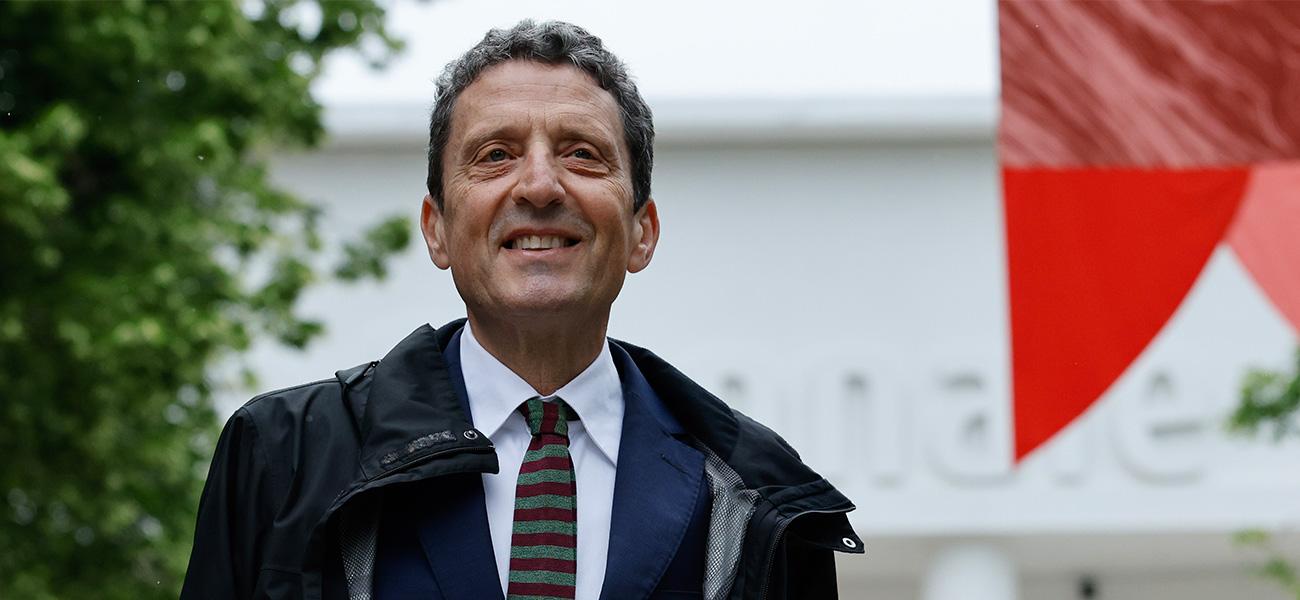
When I invited Koyo Kouoh to join me at La Biennale headquarters, we met next to that extraordinary weeping fig. Extraordinary because it was lovingly cared for by one of my predecessors, Paolo Baratta, who knew how to prune it sagely, a sense of care that was later inherited by Roberto Cicutto. Hence, it is a tree that has accompanied the efforts of various chairpersons. On that occasion, Koyo said to me: “I would never have expected to be called to Venice to lead the contemporary art exhibition by you.” In that previously unspoken thought, then made explicit, there was a precipitate of prejudgment, the thought of which amused us. With her direct approach, she then added: “You are Sicilian, therefore African.” The smile of someone who knows, a prelude to the essential point: the centre.
And between us Gurdjieff’s notion cunningly appeared, a reference to a permanent centre of gravity. “Let’s seek it out together,” she concluded. Later, she posted a story on Instagram: Venice against the notes of Franco Battiato’s song Centro di gravità permanente (Permanent Centre of Gravity). It was a subtle and secret way for us to understand and communicate with each other prior to the announcement of her appointment some months later.
It is care that explains and reveals our active engagement in the world, in its thrownness; it is the intentionality of being there, of finding oneself in this world through relationships with others. Care was therefore the premise from which this journey with Koyo began. And yet that weeping fig remains: it evokes sowing, the tree that moves, that is set in motion. So the plants, the trees, the forests: all on the move, as in Alberi sapienti e antiche foreste (Wise Trees and Ancient Forests), a book by Daniele Zorzi that I had read shortly before meeting her. There is a progression of poets, and indeed man dwells poetically. He is the tree, the root, the seed; he is the forest on the move with Koyo. In short, it would be hard to imagine a more doric Biennale Arte than this.
Koyo Kouoh’s exhibition bears the hallmarks of the universal and of the future. Beneath that tree, she had glimpsed the only possible solution: a reconnection with life and the Earth. And in the shade of another tree, a large mango laden with fruit, this time in Dakar, Senegal, in the court yard of RAW Material Company, the institution she founded, the thought continued to unfold. That’s where the project of a lifetime of study and research is rooted. That is her legacy. The pages of In Minor Keys, which Koyo sent to La Biennale almost a year ago, offer a striking insight into her curatorial practice and spell out a crystal-clear notion of her own concept of an exhibition.
Koyo presents us with this concept through the very idea of sowing seeds, and it is through her teachings that her team and La Biennale di Venezia now offer it to the world. It is an exhibition permeated with spirit, with a sacredness that places the person, the human being, back at the heart of things, rediscovering the sense of being in the world by reacquiring a sense of proportion with respect to all earthly elements, and by looking to the sky once more.
The path is one that reappraises human relationships, the little things, which are also great ones. The human dimension, the benchmark of everything, which a part of the world, yet the most opulent and over developed world – identified in the name “West” – has long since lost sight of, misplaced. Thus, from the powerhouse of Africa, and from one of its leading voices, comes a whisper that leads us back to authenticity, acknowledging that the greatest happiness lies in the use of our own hands – a revelation that brings us back to the Earth, to our bodies and our senses. To a humility towards what is greater than us and what cannot be explained but merely intuited. There are gardens, plants, the scents of fruits and flowers. There are sanctuaries, in the form of Lares and Penates, to look to so as not to stray from the main path, namely the figures of Issa Samb and Beverly Buchanan, to whom, by logic, we cannot but compare Koyo herself, now she has rejoined the world of the invisible and the immaterial. And then there are the Schools, examples of sociality and the driving force of connection between people. Performative rituals, such as processions. The importance of sentinels, guardians, those who accompany, protect and guide us throughout our existence, displayed here as mythological sirens. And then there is rest, human rhythms, the breaks that will form an integral part of the journey through this Biennale Arte, like pauses in music.
And the joy of authentic art, that which so faithfully resembles real life.