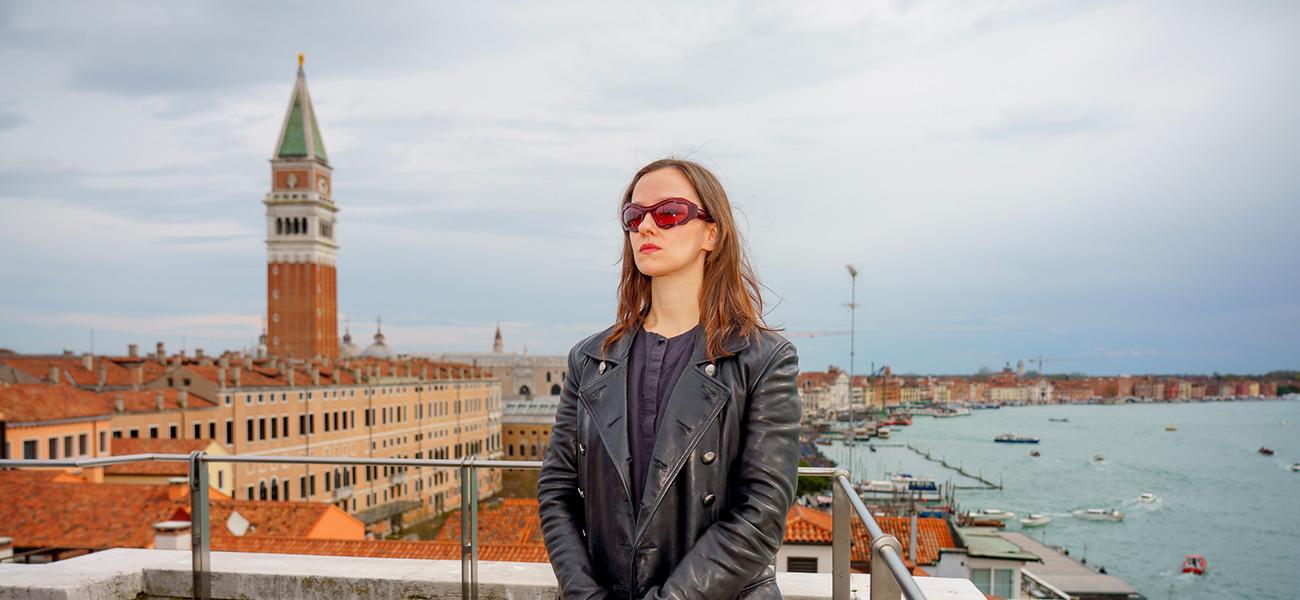
Introduction by
Caterina Barbieri
Director of the Music department
The Child’s faith is new
Emily Dickinson
Music is the childhood of the spirit: an experience that reconnects to a primordial state of openness, vitality and creative power. The grace of the child who looks at the world with the awe of his first gaze, or rather his first listening, with respect for its mystery, is the same grace with which music disarms us.
The aurora of the soul, music precedes the logic of language and strikes us in the most vital, purest and deepest part of feeling. Music also means singing the pain of birth, the loss of fusional unity, to find it again in the ecstasy of sonic unison. For many artists, music has been an instrument of purification and healing since childhood: a natural cathartic process, through which the pain of the world is transformed into beauty thereby protecting the human essence. This is a gift, as well as a duty for the artist: to share and offer the community the therapeutic and redemptive power of music.
A Child of Sound is thus the starting point to build a Biennale Musica that first and foremost restores the deepest value of sound as a collective catharsis.
The composer, philosopher, visionary and mystical Benedictine nun of the High Medieval era, Hildegard von Bingen, describes music as therapy of the soul, a bridge between earth and sky, a “symphony of creatures” in which every living thing participates. In the monasteries she founded, song was an integral part of daily life, understood as a spiritual act that can elevate and connect humans to their original harmony.
A glimpse into the divine, music makes the intangible tangible, becoming a fleeting embodiment of mystery, like a child who lives near the secret of things and respects what cannot be said of them. Like childhood that exists in the here and now, music brings us back to the sacrality of the present, revealing what is eternal about time. “He who has never thought about death is perhaps immortal” declared Carmelo Bene.
A feast of the senses, music enchants bodies and minds, making and unmaking airy cathedrals of feeling: every instant we are reborn in sound, like enamoured dust that vibrates in resonance, touching the interconnectedness of everything that lives.
At a time in which the saturation of reality seems to make us increasingly deaf – not only to pain, but also to joy, ours and that of others – reopening ourselves to listening is imperative today. “A bell was calling back to shore / your sun-drenched joy/ of a child” wrote Antonia Pozzi.
But even reclaiming silence, in the omnipresence of daily clamour, is vital today: silence as the first condition of listening, the seed from which all the melodies of the possible sprout.
The concert is therefore a unique opportunity to stop, to start from silence once again to begin listening and connecting to ourselves and the other, allowing ourselves to be disarmed by music.
That first experience of listening, which is for virgin ears only, is revelatory not only for understanding the music of the present, free from the filter of prejudice or the categories that confine the imagination, but also to start to live again, rather than merely survive, in the contemporary age.
Perhaps this revelation also contains the potential for a revolution, undertaken with the same commitment and devotion with which a child dedicates himself to play, breaking the rules to create new ones, just as the artist necessarily violates the rules of the known to generate innovation.
One of the central figures of the European avantgarde, Karlheinz Stockhausen, frequently linked musical experimentation to the child’s capacity to play with sound, repeatedly asserting that the musician must maintain a mode of listening similar to that of a child: a virgin, non-judgmental listening, free of stylistic expectations or cultural conventions: childhood is thus the original place of radical listening.
Inspired by the child of sound as a symbol of both revolution and healing, La Biennale Musica 2026, titled A Child of Sound, presents an unprecedented programme of world premieres and site-specific works that involve some of the most interesting, innovative and multiform voices in contemporary music, beyond every rigid distinction of genre, era and style, in keeping with the curatorial approach adopted last year.
The programme includes many original commissions and collective works, which explore dynamic and participatory modes of listening.
The musical projects featured at the festival span a wide spectrum of practices and genealogies of sound, bringing together the pioneers of radical experimentation and new voices in contemporary composition. The icons of improvisation and the avantgarde include Keiji Haino, Golden Lion for Lifetime Achievement of Biennale Musica 2026, and Laraaji, master of sound meditation and ambient music, while the opening event of the Festival will feature two original commissions for young guitarists in motion entrusted to Danish composer ML Buch and Venetian composer Gigi Masin, who will also present a new performance of his cult album Wind.
Two in particular stand out among the new voices in contemporary composition: Canadian Kara-Lis Coverdale, with the world premiere of Changes in Air, and Sarah Davachi, the Silver Lion of Biennale Musica 2026, who in addition to her solo work for chamber organ, will present a new commission from La Biennale for the Italian ensemble PMCE and chorus. The programme interlaces historical and contemporary repertoires, from the dialogue between Ennio Morricone – with the world premiere performance of Musica per una fine based on a poem by Pier Paolo Pasolini – Johann Sebastian Bach, Anton Webern and Sarah Davachi – through the Renaissance-era sacred music performed by The Tallis Scholars, in a programme that ranges from Hildegard von Bingen and Gregorio Allegri, to Arvo Pärt and a new commission by Coverdale.
The festival also explores ritual and transcultural musical practices with the world premiere of the collaboration between American artist Lyra Pramuk and Iranian percussionist Mohammad Reza Mortazavi.
Also framed within a transcultural and Afro-diasporic perspective is the project by the Italian guitarist Walter Zanetti, who in Cantos Yoruba de Cuba translates the rhythms and ritual structures of the batá drums of the Afro-Cuban Santería tradition into the intimate dimension of the classical guitar.
A significant section of the festival is dedicated to Italian electronic minimalism, setting up a dialogue between rediscovered figures of the past and a new generation of composers. Alongside Venetian Gigi Masin, a pioneer of electronic ambient music, and Francesco Messina, who presents a new reading of the legendary Prati Bagnati del Monte Analogo, emerge some of the most coherent voices of the contemporary electronic scene: Marta De Pascalis, with the world premiere of a new work built upon hypnotic stratifications of analogue synthesisers and tape loops, and Grand River, who presents the world premiere of a new project for guitar and electronics soon to be issued on the historic avantgarde record label Editions Mego.
On the side of electronic and audiovisual experimentation, come the Kenyan composer KMRU with the multisensory production As Nature, the Japanese pioneer Phew, and cult figures of the techno scene DJ Nobu and Carrier, joined by next-generation artists Loidis and the Dj Liwutang.
The trajectories of global dance also come to the fore in the showcase of the Príncipe label with Nidia and Helviofox, along with the Singeli scene from Dar es Salaam with Jay Mitta and Dj Travella.
The festival will close with the French orchestra ONCEIM, which will present new orchestral works between composition and improvisation by Ellen Arkbro and Caterina Barbieri, followed by the Italian premiere performance by Scottish composer and singer Clarissa Connelly, before the dancing epilogue entrusted to the Singeli showcase. In this mosaic of world premieres, original commissions and site-specific projects, Biennale Musica 2026 sets up a dialogue between distant musical genealogies and new forms of collective listening, affirming music as a space of experimentation, transformation and shared experience.