Theatre -
The 2026 Lion awards for Theatre
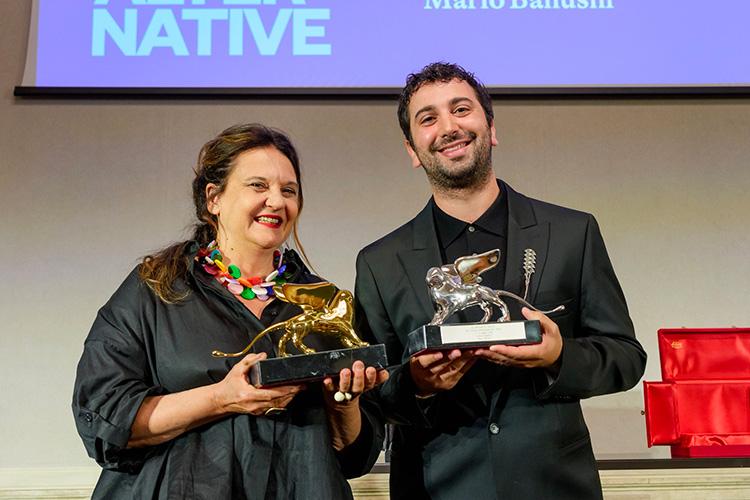
The Golden Lion for Lifetime Achievement goes to the director Emma Dante; the Silver Lion goes to the Greek-Albanian director Mario Banushi. Awards ceremony on Friday 12 June at 12 noon CEST.
The awards
Emma Dante, the most celebrated Italian director of theatre and opera, is the Golden Lion for Lifetime Achievement for Biennale Teatro 2026; the twenty-seven-year-old Greek Albanian director Mario Banushi, who gained early recognition on the European and international stage, is the recipient of the Silver Lion.
The decision was made by the Board of Directors of La Biennale di Venezia at the recommendation of Willem Dafoe, Director of the Theatre Department. The awards ceremony took place on 12 June at 12 noon during the 54th International Theatre Festival (7 > 21 June) in the headquarters of La Biennale at Ca’ Giustinian, Venice.
Emma Dante
Golden Lion for Lifetime Achievement
Emma Dante is an artist, a woman who, starting from Palermo, from the heart of her Palermo – reads the motivation – has brought Sicily to the forefront, reinvigorating the great legacy of Luigi Pirandello, Leonardo Sciascia and Andrea Camilleri, as well as Ciprì & Maresco or Franco Scaldati, boldly pursuing not only a unique experimentation with language, but also bringing the power of theatre to the vexatious and painful themes that have always seemed to denote her homeland. In this experimentation, Emma Dante has carried with her, in an eternal and sorrowful confrontation, the themes of family, death and lamentation, dreams and imagination, love and violence: elements in which she has steeped her creativity and her idea of theatre, achieving a distinctly personal and recognizable language. With irony, empathy and affection, Emma Dante has evoked on stage a theatre built on extraordinary simplicity and humanity, which turns its gaze on the meek, the forgotten, the outcasts, on the human and urban marginalities that she has portrayed like few other artists.
Born in 1967, a graduate of the Accademia Silvio d’Amico in Rome, following a successful career as a performer (alongside Valeria Moriconi, among others), Emma Dante took her first steps as a director with the Sud Costa Occidentale company founded in Palermo in 1999, and began to make a name for herself at the dawn of this new century.
In 2004, she brought to Biennale Teatro La scimia, a memorable work inspired by Le due zittelle by Tommaso Landolfi, in an adaptation for the theatre by Elena Stancanelli. Invited to work in the major theatres of the world – from the Piccolo Teatro in Milan to the Comédie Française in Paris, from the Teatro alla Scala in Milan to the Festival d’Avignon, to the La Colline Théâtre National, to the San Carlo in Naples, the Biondo in Palermo and many others – Emma Dante has expanded her research territory, taking on cinema – the film Via Castellana Bandiera premiered at the Venice Film Festival in 2013 – novels and fairy tales for children.
At the 54th International Theatre Festival (Venice, 7 > 21 June) Emma Dante will present the world premiere of I fantasmi di Basile. Following the trilogy that brought to the stage La scortecata, Pupo di zucchero and Re Chicchinella, Emma Dante returns to the highly imaginative and baroque world of the Neapolitan author Giambattista Basile.
Mario Banushi
Silver Lion
“With his almost autobiographical storytelling, which ranges across the experiences of mourning, lamentation, absence and family traditions, Mario Banushi – reads the motivation for the award – has revealed himself through his poetic, elliptical language, made of silences rather than words, yet evocative and painfully communicative. Memory, everyday sounds, and the little things in life are the cornerstones around which intimate yet shared, universal ceremonies are celebrated. Memories, dreams, coexistence and loss unfurl in sequences of only apparently simple actions that – on the contrary – between radical realism and perspectival flights into abstract dimensions, open up to symbolic journeys into the archetypes of the human. Banushi’s theatre, so immediately intimate and deeply rooted in the Balkan culture, also knows how to be intelligently political, a sharp stab at the contradictions of our time”.
Raised in Albania through the age of six before returning to Greece where he was born in 1998, Mario Banushi graduated from the Drama School at the Conservatory in Athens. He made his debut as a director with Ragada, created and presented inside a private apartment during the pandemic. The director of the National Theatre of Greece, who attended the last day of the show, later invited him to collaborate. This led to the creation of his next work, Goodbye, Lindita. Scheduled to run for three weeks, it played at the National Theatre for three years, to great critical and public acclaim, before touring around the world. The third chapter in the trilogy, Taverna Miresia, acclaimed at the major festivals around the world, would enjoy the same success.
At the 54th International Theatre Festival Mario Banushi will present the entire trilogy, titled Romance Familiare, for the first time. As Banushi declared to the New York Times: “I want to create theatre that people feel, not theatre people understand. I want you to imagine your own stories, see your own life, then live with this”. This trilogy will be presented by La Biennale di Venezia as a co-production with the Fondation Cartier pour l'art contemporain.
The awards of the previous editions
In the past the Golden Lion for Lifetime Achievement in Theatre has been awarded to Ferruccio Soleri (2006), Ariane Mnouchkine (2007), Roger Assaf (2008), Irene Papas (2009), Thomas Ostermeier (2011), Luca Ronconi (2012), Romeo Castellucci (2013), Jan Lauwers (2014), Christoph Marthaler (2015), Declan Donnellan (2016), Katrin Brack (2017), Antonio Rezza e Flavia Mastrella (2018), Jens Hillje (2019), Franco Visioli (2020), Krzysztof Warlikowski (2021); Christiane Jatahy (2022); Armando Punzo (2023); Back to Back Theatre (2024); Elizabeth LeCompte (2025).
The Silver Lion, dedicated to the most compelling voices in theatre in recent years, or to institutions that have distinguished themselves for cultivating new talents, has been awarded to Rimini Protokoll (2011), Angélica Liddell (2013), Fabrice Murgia (2014), Agrupación Señor Serrano (2015), Babilonia Teatri (2016), Maja Kleczewska (2017), Anagoor (2018), Jetse Batelaan (2019), Alessio Maria Romano (2020), Kae Tempest (2021), Samira Elagoz (2022); FC Bergman (2023); Gob Squad (2024); Ursina Lardi (2025).
Biographical notes
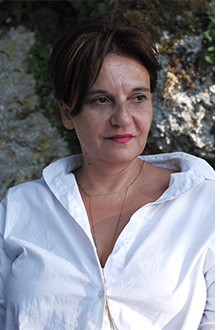 Emma Dante (Palermo, 1967)
A graduate in 1990 of the Accademia Nazionale d’Arte Drammatica Silvio D’Amico in Rome, in 1999 she founded the Sud Costa Occidentale company in Palermo, with which she won the Scenario 2001 prize for the mPalermu project and the Ubu 2002 award for best new Italian play. In 2003 she won the Ubu award for best new Italian play again for Carnezzeria, and in 2004 the “Gassman” award for best Italian director and the critics’ award for playwriting and directing. From the theatre to a book: Carnezzeria. Trilogia della famiglia siciliana (Fazi, 2007) with a preface by Andrea Camilleri. In 2004 she came to Biennale Teatro in Venice with La scimia, adapted from the novella Le due zittelle by Tommaso Landolfi. Her first novel, Via Castellana Bandiera (Rizzoli 2008), won the Vittorini and Super Vittorini 2009 award. The novel would later become a film, which premiered in competition at the 70th Venice International Film Festival of La Biennale di Venezia (2013), and won Elena Cotta the Coppa Volpi for Best Performance by an Actress.
From 2000 to 2011 in Italy and abroad, she presented: mPalermu, Carnezzeria, Vita mia, Mishelle di Sant’Oliva, Medea, Il festino, Cani di bancata, Le pulle, La trilogia degli occhiali.
In 2009 she won the Sinopoli award for culture. That same year she inaugurated the season at La Scala as the director of Bizet’s Carmen, conducted by Daniel Barenboim. She followed with the direction of many operas: La muta di Portici by Auber at the Opéra Comique in Paris (2012), and later produced at the Teatro Petruzzelli in Bari (2013), winning the Abbiati award (2014); Feuersnot by Strauss (Teatro Massimo, 2014); Gisela! by Henze (Teatro Massimo, 2015); La Cenerentola by Rossini (Teatro dell’Opera in Rome, 2016); Macbeth by Verdi (Teatro Massimo, 2017); La voix humaine by Poulenc and Cavalleria Rusticana by Mascagni (Teatro Comunale di Bologna, 2017); The Fiery Angel by Prokofiev (Teatro dell’Opera in Rome, 2019); La Bohème (Teatro San Carlo, 2021); I vespri siciliani by Verdi (Teatro Massimo, 2022); Les dialogues des Carmélites by Poulenc (Teatro dell’Opera in Rome, 2022); Rusalka by Dvořák (Teatro alla Scala, 2023).
Le Sorelle Macaluso, a play staged in 2014, won the Le Maschere award for best play, the Critics’ Award and two Ubu Prizes for best direction and best play. In 2020 it would become a film that premiered at the 77th Venice International Film Festival of La Biennale di Venezia, winning the Pasinetti Prize for Best Film and the Coppa Volpi for Best Actress for the entire cast.
In 2014 she was appointed artistic director for the 67th cycle of classical theatre at the Teatro Olimpico in Vicenza. She was principal director of the Teatro Biondo and the “School of Performing Arts” established within the resident theatre of the city of Palermo. In 2014 she also won the De Sica Prize for theatre and the Ipazia Prize for excellence by women.
In 2017 she premiered Bestie di scena at the Teatro Strehler in Milan and La scortecata at the Festival of the Two Worlds in Spoleto. At the Teatro Greco in Siracusa, she presented Euripides’ Heracles (2018) and at the La Colline Théâtre National in Paris Fable pour un adieu, freely inspired by Andersen’s The Little Mermaid (2019). In 2020 Misericordia premiered at the Piccolo Teatro Grassi in Milan, and was later adapted into the eponymous film which premiered at the 18th Rome Film Fest in 2023. In 2025, L’angelo del focolare premiered at the Piccolo Teatro Grassi in Milan. She is currently directing Molière’s Les femmes savantes at the Comédie Française in Paris.
 Mario Banushi (Athens, 1998)
Mario Banushi is an award-winning theatre director whose work has been presented internationally in cities including New York, London, Berlin, Milan, Vienna, Montreal and Taipei. His artistic practice moves between intimacy and myth, memory and family, articulated through a rigorously visual and non-verbal theatrical language.
Born in Greece and raised in Albania until the age of six when he moved back to Greece, his artistic universe is shaped by the idea of displacement, by family narratives and a distinct visual sensibility. His works have been noted for their visual poetry and emotional depth, unfolding without words and inviting audiences into a sensory experience that transcends conventional theatre.
He studied acting at the Drama School of the Athens Conservatory, graduating in 2020. That same year, he directed his first short film, Pranvera, which was selected for the Tirana International Film Festival. His debut in theatre, Ragada, was created and presented in Athens during the pandemic lockdown, marking the beginning of a practice developed outside conventional theatre spaces.
In 2023, Banushi premiered Goodbye, Lindita at the Experimental Stage of the National Theatre of Greece. The work quickly resonated with audiences and critics alike, leading to sold-out performances and invitations to major international festivals, including the Vienna Festival, the International Theatre Amsterdam, the Adelaide Festival, and BITEF in Belgrade, where he received both the Jovan Ćirilov Special Award and the Politika Award for Best Director. His subsequent work, Taverna Miresia – Mario Bella Anastasia, premiered at the Athens Epidaurus Festival and has been touring internationally in multiple cities, including London, Montreal, and Taipei. Together with his earlier works, it forms the triptych titled Romance Familiare, a cycle that explores family memory through image-driven, text-free theatrical storytelling. His work has been featured in The New York Times and the BBC, and reviewed by The Guardian, Le Monde, and Libération, reflecting the growing international attention surrounding his work. Banushi’s most recent production, MAMI, is an international co-production with leading European festivals and institutions. Premiering in 2025 at Onassis Stegi, the work deepens his poetic and visual language and was met with widespread acclaim following its presentation at the Festival d’Avignon, where critics praised its emotional precision and visual excellence. In 2025, Mario Banushi received the New Theatre Artist Award from the Hellenic Association of Theatre Critics.