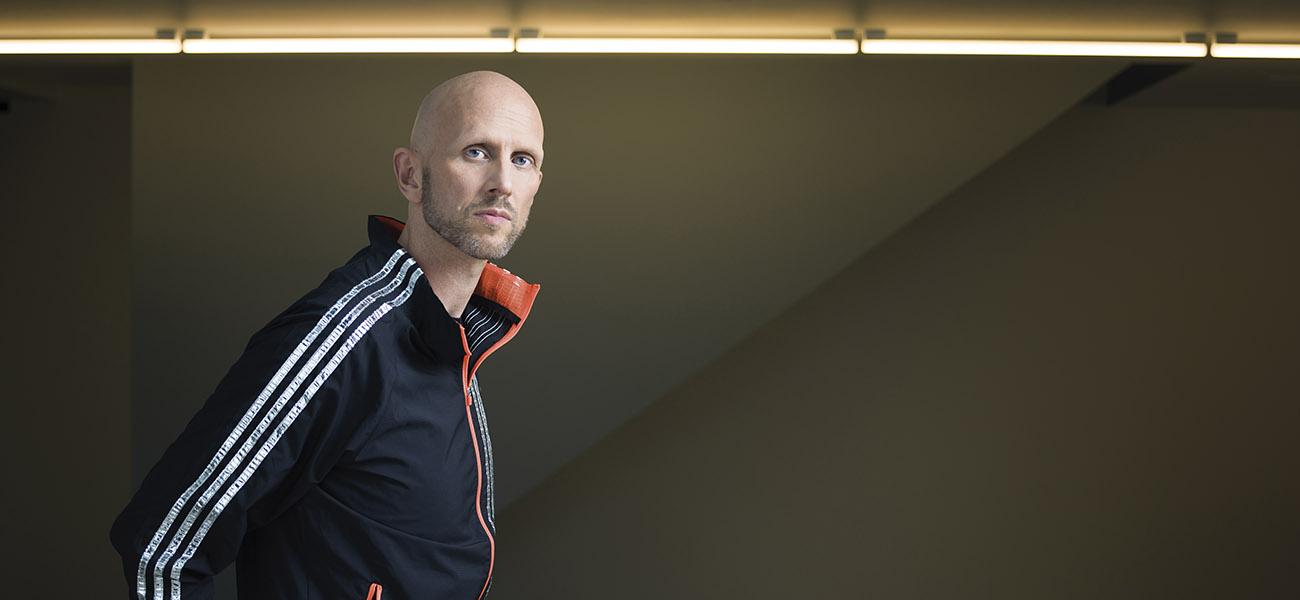
Introduction by
Wayne McGregor
Director of the Dance department
The dazzling physicist Carlo Rovelli, known for his work in quantum gravity and the philosophy of science, argues that time, as we understand it, does not exist in the conventional sense. His views challenge the traditional perception of time as a continuous, flowing entity and instead suggest that time is deeply intertwined with the fabric of physics and our understanding of the universe. Rovelli’s relational theory views time not as an absolute dimension but as a relationship between events, emerging from interactions among systems. Our perception of time, he argues, is subjective, influenced by cognitive processes, and at the quantum level, the traditional concept can break down totally. Time is a product of changing relationships and states, not a fundamental aspect of reality, inviting a profound rethinking of how we conceptualise time.
Rovelli’s ideas on the non-linearity and multiplicity of time have been at the forefront of my mind as I immerse myself in the history of the Biennale Danza Festival, which will mark its twentieth ‘official’ birthday in 2026. Systematically and chronologically revisiting the legacy, I reach back into the archive, attempting to rewind and reflect, extracting from history the figures, facts, and narratives of the past. An ephemeral jigsaw emerges, offering only a shadow of the embodied experiences of yesterday, but nonetheless one that I am grateful to touch. Again and again, the dancers, the choreographies, the concepts, the photographs, the artefacts, the knowledge, the intelligence coalesce, overlap, and superimpose—sometimes in parallel journeys, years and artists apart, and at other times in tree-like branching, rivers of imagination and innovation carving their own paths in the wilderness—out of time and out of sync with everything that surrounds it. This living archive creates a non-manifest body with a consciousness beyond—much wider than our self.
Then I realise that “Time does not exist” – and in some fundamental way, dance artists have always understood this, inviting us to feel a sense of wonder and curiosity about the nature of reality.
The artists in Biennale Danza 2026 are like (and unlike) our past dance time travellers who, in their own unique ways, explore and depict multiple timelines, perspectives, and realities through their work. Instead of viewing time as linear—a sequence of past, present, and future events—time can be seen as non-linear, where past and present intertwine, with events existing in a state of probability rather than fixed sequences. This shift – a defining characteristic of all dance making - offers audiences multiple interpretations of experience rather than a single, fixed perspective, changing how ‘narratives’ are understood and how we, as viewers, receive and absorb work. Fascinatingly, this approach embodies and mirrors the latest scientific principles of quantum superposition – the extraordinary ability for multiple things to occupy the same space or to exist in all possible states simultaneously. Perhaps unknowingly, choreographers, dancers and audiences have always been secret quantum experts.
Our evolving understanding of time, influenced by concepts from quantum mechanics, is reshaping our perspectives in various fields, including the arts. Take, for example, the idea of entanglement in quantum mechanics, where particles can be interconnected regardless of distance. Artists have always engaged in partnerships across different mediums, cultures, and time frames, creating works that reflect a shared consciousness or collective human experience. This interconnectivity, evidenced in much of the work in Biennale Danza 2026, encourages a deeper exploration of how individual and collective histories shape artistic expression and our fundamental understanding of reality.
This profound exploration of time, or rather a time that does not exist, at Biennale 2026 profoundly engages with themes of memory, identity, and existence, encouraging our audiences to reflect on and perceive their connection with their own lifetime – an invitation to changing relationships and states.
For the next twenty years of Biennale Danza – now more than ever, we need a place of congregation and community that centres our attention on the incredible, diverse worlds of dance. A convening of global creativity, innovation and artistry where provocative new voices are surrounded by legendary artists with voices still powerfully engaged. A space of nurturing and investment in and for - a critical and healthy dance and broader art ecology. A sanctuary of the imaginary and the possible – time less.
The programme
We begin Biennale Danza 2026 with the remarkable Bangarra Dance Theatre (our Golden Lion and European Premiere), Australia’s original First Nations dance theatre company, which advocates for and celebrates Aboriginal and Torres Strait Islander cultures through astonishing art making. In Terrain choreographed by Frances Rings and featuring an irrepressible score by David Page, Bangarra presents a breathtaking exploration of the Northern South Australian desert’s Kati Thanda – Lake Eyre. Evoking the power of body and land converging to bring spirit to place, we feel the ancestral ties that bind people to Country: a rich cultural spine stretching through the generations. Watch the waters rise and fall as we reconnect with the energy of land and the resilient spirit of the people who care for its future, as we are invited to:
Come, come with us to Kati Thanda-Lake Eyre.
Where the cracked salt blinds and the silence deafens.
Where the long shadows sweep towards the horizon, waiting for the deluge.
Come with us to Country.
In an explicit disturbance of the codes of unexamined power, privilege and patronage, our Silver Lion, South African artist Mamela Nyamza presents The Herd/Less (a Biennale Danza Co-Commission and European Premiere). Embracing the dual meaning of the word “herd”: a group of people or animal species that live, eat, and behave in a harmonious environment; but also referring to a collective of beings (animals and humans) controlled through cultural or physical tools as a group rather than as individuals.
The Herd/Less uses symbolic yet powerful everyday weapons that represent power, identity, and social status—tools for controlling the ‘herdless’ - the spear, the arrows, the knobkerries, the whips, and the cloth and animal skins, creating sounds and physical expressions of pondering and perplexity. It is a performance of desperation, defiance and the detonation of a systematic and symbolic weaponry of fallacy in our realities.
In a Biennale co-commission and Italian premiere, celebrated choreographer and movement innovator Emanuel Gat presents his new work Five Days in the Sun at Biennale Danza 26.
Comprising five choreographic tableaux, each inspired by the five movements of Mahler’s Fifth Symphony, opening five choreographic portals into a profound emotional and structural journey through the human experience. A rich tapestry of emotions, Five Days in the Sun shifts from darkness to light, despair to joy, and tension to release, offering a contrast between solemnity and ecstasy, introspection and outward motion. It weaves a sweeping narrative exploring themes of love, mortality, transformation, and catharsis.
Launching When, If Not Now?, a new dance company of world-class artists aged 40 and over at Biennale Danza 26 (including the superstar dancer Diana Vishneva) is a rare privilege – WINNDance Company aims to transform perceptions of ageing in dance performance, challenging the limitations imposed by industry standards and demonstrating that artistry, passion, and dance talent have no expiration date. In a world premiere and Biennale co-commission, legendary choreographer John Neumier joins Imre+Marne van Opstal, and Oman Román de Jesús in the project Scirocco, which brings two chapters into dialogue: Death in Venice and Bridge of Sighs.
Adam Linder is a pioneering and interdisciplinary artist developing a practice that utilises carefully crafted dance vocabularies to explore how choreography relates to desire, value, technology, and collective psyche. In his latest work for Danish Dance Theatre, Drip Tekhne, he imagines how evolution shapes our bodies into tools for dance. Linder's work is full of unexpected genre-crossings, aiming to erase the boundaries of the language and expression of dance. He questions the traditional and normative understanding of choreography, weaving together movement, pop culture, music, visual art, architecture, and fashion into an exceptional aesthetic.
Franco-Malagasy dancer and choreographer Soa Ratsifandrihana searches for a vocabulary between bodies and history to understand what links them and what sets them apart. Fampitaha, fampita, fampitàna which means comparison, transmission and rivalry in Malagasy, four bodies, including guitarist Joël Rabesolo, challenge each other, choose each other and purge themselves of the (layers of) violence that constitute them. The performance is presented as a rediscovered line of dialogue between the children of diasporas and their places of origin. A plural narrative in which the shattering of these experiences is as vibrant as their reappropriation. Written out before us is the story of bodies that would never have left their islands, and which, together, are fashioning a parade against exile.
Why, 80 years after the end of the Second World War, do we still have wars? Two multidisciplinary artists from very different countries, with a history of animosity toward each other, began their collaboration with this question. Eiko Otake who grew up in postwar Japan, has lived in New York City since 1976. And Wen Hui who grew up in China during the Cultural Revolution, now lives in Frankfurt, Germany. What urgency brought them together? What learning will they share with us?
Conceived, choreographed, and performed by Wen Hui and Eiko Otake, What Is War explores the personal, cultural, and national relationships to war unearthed from the suppressed stories rarely discussed openly by parents, grandparents, families, friends, and ourselves. Deeply moving, at times beautiful, brutal, compassionate, and powerful, the piece combines movement, stories, video projections, languages, voices, a mirror, silence, and sound, to escort the viewer through memories and experiences, history and imagination, individuals and nation-states, as we realize and are reminded that war connects us all through generations – no matter how intimately or distantly.
Enigmatic choreographer Molissa Fenley’s celebrated solo work, State of Darkness, finds fresh life in Venice, performed by a new generation of acclaimed dancer, US powerhouse Cassandra Trenary. Originally commissioned by the American Dance Festival in 1988, State of Darkness challenges Stravinsky’s cacophonous Le Sacre du Printemps (The Rite of Spring) with an intense 35-minute solo performance of relentless fervency, technical precision, and fearless abandon.
Fenley remains a vital force in dance, not just as a choreographer but also as a performer. The 71-year-old has been the leading interpreter of her own work since she burst onto the scene in the late 1970s, with pieces characterised by athletic rigour and propulsive rhythmic drive. At Biennale Danza 2026, we get to witness this tornado live in her Bardo.
Dance People is a title that speaks for itself. It highlights the values of community at the heart of creativity, claiming its presence through sharing the space with citizens and allowing new formats of ‘being together’ to emerge. In a world moving towards intelligent algorithms, data-driven minds, and AI, It seems that some of the most urgent questions today are those related to meetings, gatherings and living together. What is the space of a democracy? A dictatorship? The space of culture? Identity? Sharing space, opening the space, protecting the space, and occupying space, is what this performance explores with the artists and citizens. How to belong to the space of the other and how to allow the other to belong to your space? Choreographers Omar Rajeh and Mia Habis invite several artists from different cultural and artistic backgrounds to join them in a collective creative process. The aim is to create an interactive performance evening that opens the possibilities of sharing the space with an audience. Dance People is a festive, joyful artistic event that is also critical of structures of power and supremacy.
The work of visual artist, magician, and stage director Kalle Nio blends magic, visual arts, cinema, art history, circus, and theatre into a unique artistic language. Drawing inspiration from 19th-century stage magic, Nio reimagines its elements as the foundation for his visually striking explorations of the human body and interpersonal relationships within contemporary society. In this collaboration with Brazilian choreographer Fernando Melo - Tempo explores time – its perception, acceleration, deceleration, and eventual end. At the heart of the performance is an apparently insignificant event that takes on grand proportions, revealing the fragility of life. Boundary blurring brilliance.
The groundbreaking work of choreographer, director and film-maker Elle Sofe Sara draws strongly from Sámi culture, which is Indigenous to the Northern parts of nations now known as Sweden, Norway, and Finland; and from Russia’s Murmansk Oblast. A culture born of a fierce climate of ice, the animal world, and quiet intimacy. Deeply human, we all yearn to belong, to feel held by others, to feel at home in the natural world and, perhaps, to navigate our lives with the use of ancestral knowledge. We welcome you to an old world of new possibilities. In a startling collaboration with the Norwegian National Ballet and choreographer Hlín Hjálmarsdóttir - Láhppon/Lost, with music by Valgeir Sigurðsson is a physical narrative of the 1852 Kautokeino rebellion – one of the most violent in Sámi history - a turning point after years of conflict between the Sámi and the Danish-Norwegian authorities. Newly composed joiks – traditional chanting songs of the Sami people – along with costumes and sets designed by star fashion designer Henrik Vibsko, unfold on a futuristic stage landscape that playfully interacts with nature and tradition, reflecting Sámi customs, building practices, and techniques.
The Italian artist and choreographer Andrea Salustri, with Invisible and the New Zealand dancer and choreographer Oli Mathiesen, with Just Between Me and Jesus, are the 2026 winners of the call-outs – national and international – dedicated to new choreographies, selected after an overwhelming number of submissions: almost 700 artists and companies applied. At both the national and international levels, companies are demonstrating a real need for artistic and developmental support and nurturing. This programme feels like a lifeline to artists at a time when new work and young voices are largely being ignored.
Biennale College has consistently been a key part of all Biennale Danza editions, with its programme evolving and refining over the years. Our goal to connect emerging young talent with exceptional learning, training, mentoring, and creative opportunities is bolstered by the outstanding instruction and mentorship from renowned artists like Pite, Forsythe, Xie Xin, Teshigawara, Forti, McGregor, Caprioli, Tharp, Waltz, and others. Each season, we review and update our offerings, aiming to achieve a top standard in dance training within this prestigious international series of Biennale festivals.
Again, 16 young dancers from around the world and two young choreographers will be residents at Biennale Danza 2026, taking classes, workshops, rep, and, vitally, creating new works.
Building on our aim to feature the world’s greatest living dance artists at Biennale College, we are delighted that our students will be working directly with two of the most important dance innovators of the 20th and 21st centuries – Molissa Fenley and Maxine Doyle. Molissa Fenley is one of the most influential and iconic figures in postmodern dance, founding Molissa Fenley and Company in 1977 and has since created over 85 dance works during her continuing and dazzling career. Maxine Doyle is an independent choreographer and director. Since 2002, she has been a director-choreographer for Punchdrunk, with whom she co-directed the multi-award-winning Sleep No More (London, Boston, New York, Shanghai), The Drowned Man, The Firebird Ball, Faust, Masque of the Red Death, Tunnel 228 and The Duchess of Malfi. Both singular artists are powerhouses of imagination, experience and innovation, and we are thrilled to be commissioning two new works specifically for this year’s Biennale College: On Tenderness and Hubris.
Moreover, two emerging artists will workshop, create, and present world premieres at Biennale Danza 2026, mentored by me and my team.
In celebration of the 20th International Festival of Contemporary Dance and 28 years since the official launch of the Biennale Danza programme, this landmark exhibition, created in collaboration with ASAC, will showcase and honour the achievements of this festival’s past. Through film, photographs, text, documents, objects, talks, and live interactions, this exhibition will delve into the extensive archive of Biennale Danza and explore its diverse and influential mandate – from its fundamental investment in artists and their work to its ongoing research and development of the form. Life Lines will captivate, inspire, and remind us that the body is a living archive, and the living archive is itself a body.
Curated conversation and discussion opportunities to meet artists pre and post shows - to delve deeper into their work and their artistic vision is both revelatory and insightful. We will provide extra opportunities for these encounters in 26. Continuing and nurturing our in-conversation mentoring programme with the Biennale’s new group of young dance journalists and curators, we will provide a solid foundation for their future career paths and excite our audiences with liberating debate.
Each artist presenting or performing at the Biennale Danza 26 will offer a workshop for a broad range of participants during our festival. This workshop programme allows a diverse audience of professional and non-professional dancers to experience live the incredible physical worlds of our Biennale talent. Many of these workshops will be open to the public and actively encourage amateur dancers to participate and enjoy the power of dance in action.