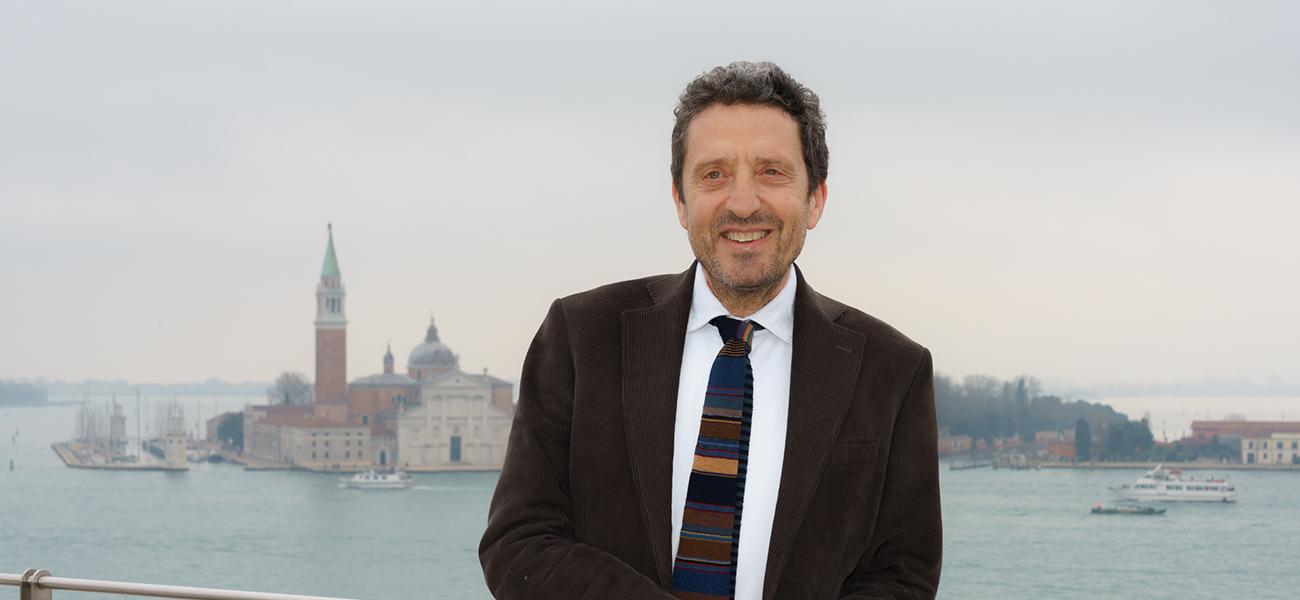
Introduction by
Pietrangelo Buttafuoco
President of La Biennale di Venezia
Driven by a deep connection to his artistic roots, in his role as Artistic Director, Willem Dafoe has returned to his original home: the theatre. As the genuine artist and Master practitioner he is, he has immediately brought us back to the basics of the craft, offering up a clear and effective pedagogical approach that focuses on the theatre’s basic unit—the body of the actor. For his first year as Director, Dafoe has selected artists he knows and admires, drawing on the ten years he spent as one of the leading figures – and indeed co-founder – of the legendary New York avant-garde theatre company The Wooster Group, which has been active since the late seventies. At the same time, he has also chosen to focus on the work of emerging companies and directors who place the actor’s body at the centre of their creative work, as well as taking particular care to develop the Biennale College, already a well-established training ground for the creative talents of the future.
The body is that exclusively human channel through which the poetry of words travels and becomes a voice, an action, a movement, a means of expression. Thus, in the midst of a decidedly evanescent era, Dafoe has reaffirmed that physical presence cannot be replaced by promises of ubiquity or flattering omniscience; that the premise for existence lies in flesh and bone; and that the here and now is at once a precondition for theatre and a confirmation of our humanity. The body is poetry (derived from the Greek poiein (ποιεῖν), to make and produce) as the presentation of the Theatre is Body – Body is Poetry programme tells us. In this sense, the theatrical text moves through the body and is embodied by it; it is the beating heart of theatre, as the primary tool of the actor, who is there to mediate the dialogue between a play and its audience. Stepping onto a stage is an exercise in freedom, one developed through the free will of gesture, the training of a voice, a feeling in the limbs. The body is thus the only truth – the most direct, delicate, and sincere – and Dafoe’s own perfect control of his body on stage has always shown the discipline, knowledge, passion, and deep awareness this demands. His long and illustrious career is indicative of this personal experience, as he has pushed himself to the physical and mental limits of the characters he has embodied. His performance in the Idiot Savant, produced in 2009 and directed by the late Richard Foreman, was a case in point, with Dafoe appearing to offer up every last vibration in the sensory catalogue to the audience. All of these elements are the dowry he has brought with him to his leadership of the Biennale Teatro. Yet laying bare the sumptuousness of the theatrical machine in order to access its primary, essential components also means going back to its origins, to a body that is both a container and a mystical device. At once touching, fragile, and the ultimate expressive tool, the body is the beauty at the heart of the theatre rite, in which Theatre itself is embodied.
Two iconic moments in Dante’s Divine Comedy might help us fully understand what it means to inhabit a body in all its consistency, here. As he moves through realms inhabited by pure spirit, Dante emphasises the material presence of his physical body by way of gravity. The line, caddi come corpo morto cade (“I fell as a dead body falls”) not only anticipates Newton’s apple tree in poetry, but also serves as a supreme image of earthly existence. And yet there is another element that separates the poet from the ethereal souls of the underworld: as he declares himself living among the dead of Mount Purgatory, he is inevitably also recognised by the shadow he casts. Roberto Longhi was the first to see a viaticum for Humanism in this moment – the precise instant in which one can be reconnected to humanity through the body – by linking the Dantean shadow to the one painted by Masaccio in his masterpiece housed in the Brancacci Chapel at the Church of Santa Maria del Carmine in Florence. Adam and Eve have been cast out of Eden. Their bodies are firmly on the ground. And it is their weeping, their despair – but above all the shadows they cast – that convey to us how they will, from this point onwards, be at the mercy of all the uncertainties of the human condition. Fittingly, a recent exhibition at the Gallerie dell’Accademia in Venice presented Leonardo Da Vinci’s artistic consideration of human proportions, The Vitruvian Man, in which the body is inscribed in the celestial perfection of the circle and the terrestrial solidity of the square. That image might then be the shadow, the measure and the basic unit of production that Dafoe has kept in mind for the 53rd International Theatre Festival that bears his signature.
Our thanks go to the Italian Ministry of Culture for its important contribution and to the Veneto Region for its support, Media partner Rai and Vela – Venezia Unica.
We would like to thank the following for their collaboration: Comune di Venezia, Fondazione Forte Marghera, Fondazione Teatro La Fenice, Teatro Stabile del Veneto “Carlo Goldoni”, Polo Museale Veneziano, la Marina Militare e Difesa Servizi, Fondazione Forte Marghera, and APS Live artscultures ETS.