| Year and length: | 2024, 80’ (Italian premiere) |
|---|---|
| Choreography: | Soa Ratsifandrihana |
| Created by: | Audrey Mérilus, Stanley Ollivier, Soa Ratsifandrihana |
| Performers: | Audrey Merilus, Stanley Ollivier, Elsy Robert |
| Music: | Joël Rabesolo |
| Dramaturgy: | Lily Brieu Nguyen |
| Artistic collaboration: | Jérémie Polin Razanaparany aka Raza, Amelia Ewu, Thi Mai Nguyen |
| Writing collaboration: | Sékou Séméga |
| Rehearsal director: | Anika Edström Kawaji |
| Light design: | Marie-Christine Soma |
| Costumes: | Harilay Rabenjamina |
| In collaboration with: | Théâtre Varia |
| Sound design: | Chloé Despax, Guilhem Angot |
| Video: | Valérianne Poidevin, Antoine Chambre |
| Touring production: | Kintana (Brussels) |
| In collaboration with: | La Cordiale |
| Co-production: | Kaaitheater, Kunstenfestivaldesarts, Théâtre Varia, Charleroi danse, MC93 (Maison de la Culture de Seine-Saint-Denis), ICI (Centre chorégraphique national Montpellier Occitanie, Centre chorégraphique national d’Orléans, Le Gymnase-CDCN Roubaix, La Place de la Danse-CDCN Toulouse/ Occitanie, Fonds Yavarhoussen, Tanz im August/HAU Hebbel am Ufer, Fonds Transfabrik, La Coop asbl, Shelter Prod, A-CDCN |
Dance
Soa Ratsifandrihana - Fampitaha, Fampita, Fampitàna
Description
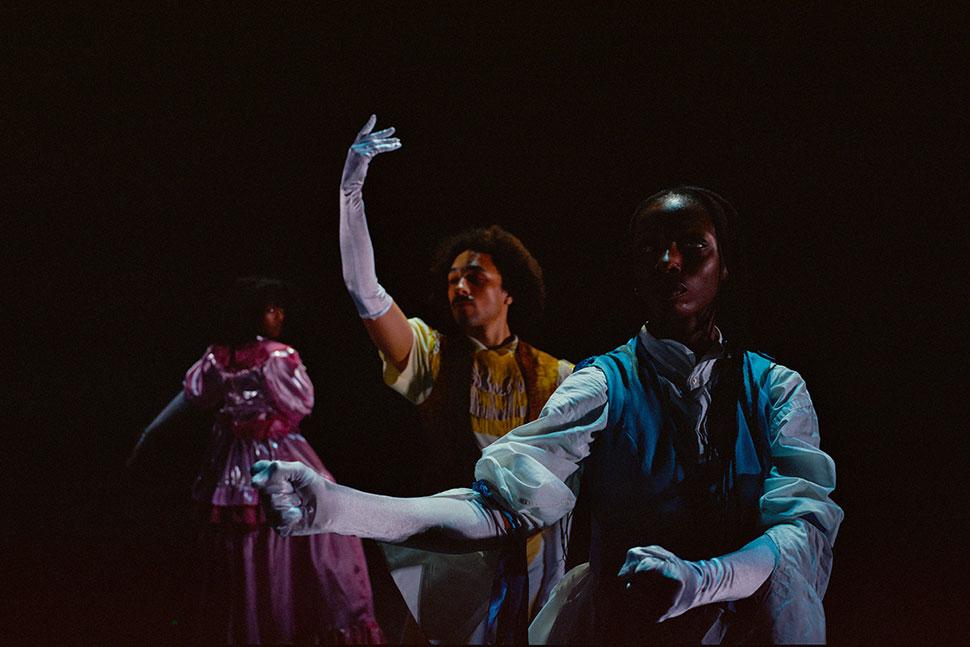
Franco-Malagasy dancer and choreographer Soa Ratsifandrihana seeks a vocabulary capable of reconnecting the children of the diaspora with their places of origin, in order to reinvent their roots. In Malagasy, fampitaha, fampita, fampitàna mean comparison, transmission and rivalry: a reference to a nineteenth-century tradition that foreshadowed contemporary dance battles, as well as the recovery of a gestural language belonging to a memory that predates colonization.
On stage, four bodies — three dancers and a multi-instrumentalist — emerge from their silence, opening themselves to the possibility of language: they challenge one another, choose one another, and attempt to purge themselves of the layers of violence that constitute them.
The second chapter of a diptych initiated with the documentary Rouge Cratère, the performance continues a dialogue with a distant past rooted in the Caribbean traditions and cultures of Haiti, Martinique and Guadeloupe, as well as Madagascar. A narrative that draws strength from plurality, in which the fragmentation of these experiences resonates as intensely as their reclamation.