Applicazioni / Applications
no. 4 / 2025
Historical Archive -
“Applicazioni / Applications”: the fourth issue of the Biennale Magazine
The new volume explores the relationship between new forms of creativity and investigates the different ways in which art enters everyday life.
Applicazioni / Applications
Applicazioni / Applications is the title of issue No. 4/2025 of the historic magazine published by La Biennale di Venezia under the aegis of its Historical Archive. Revived at the end of 2024 after fifty-three years of editorial silence, the magazine reaches with this volume the final issue of the year 2025. The publication will be previewed in Asiago (Vicenza) at Libreria Tantestorie on Sunday 4 January 2026 at 6 pm. Speakers will include Debora Rossi, Editorial Director of the Magazine, and entrepreneur Giovanni Bonotto, author of a testimony featured in the new issue.
«The Magazine is one of the activities that take shape from the Archive,” explains Pietrangelo Buttafuoco, President of La Biennale di Venezia. “The heritage that preserves the Institution’s memory — composed of documents, photographs, videos, posters, press reviews and much more — is transformed into living material for editorial projects, exhibitions, research paths and special productions. A place of memory that thus becomes an International Centre for Research on Contemporary Arts.»
The new volume explores the relationship between new forms of creativity and investigates the different ways in which art enters everyday life at a time when it is often unaware of being art. Artefacts constantly surround us, and human beings live in continuous relation with objects: they build them, produce them, use them, and employ them to embellish the environments in which they live and work, within a close interaction between design and society, craftsmanship and industry, material culture and digital culture.
Among the contributions is that of Elias & Yousef Anastas, Palestinian architects, who with the project Stone Matters investigate the use of stone in contemporary Palestinian architecture, seeking to free it from logics of domination and to introduce new economic models into the construction sector. Brendan Cormier, Chief Curator of the V&A East Storehouse in London and Curator of the Applied Arts Pavilion at the Architecture Biennale in 2016 and 2025, re-evaluates the concept of applied arts as a contemporary and relevant field capable of proposing new creative models. Danish architect Bjarke Ingels theorises the Conscious City and describes the project for Bhutan’s airport, where traditional craftsmanship and advanced technology engage in dialogue through collaboration between local woodcarvers and robotics. Giovanni Leone recounts the Electa Book Pavilion at the 1991 Architecture Biennale, designed by James Stirling, as an example of formal freedom, functional rigour and technical mastery. Julio Luzán highlights the dialogue between artisanal knowledge and technological innovation in the creation of evocative cinematic worlds. Tim Reeve, Deputy Director and Chief Operating Officer of the Victoria and Albert Museum in London, and Elisabeth Diller, architect and designer of the V&A East Storehouse, underline the continuous dialogue between curatorship and architecture, showing how collaboration between ideas and design has generated a new model of museum. Julian Schnabel outlines his path as painter and filmmaker, revealing a creative process that is an act of discovery rather than representation. Deyan Sudjic focuses on the research of Dutch designer Hella Jongerius, centred on the value of imperfection as testimony to manual gesture, the passage of time and the memory of objects. Through the voices of curators and mosaic artists involved in the International Biennial of Contemporary Mosaic in Ravenna, mosaic is presented as an autonomous artistic medium whose expressive potential remains largely unexplored. Stefano Salis describes the book not only as the primary means of transmitting knowledge, but also as an object of great beauty thanks to artisanal typography — a form of resistance to increasing digitalisation. Entrepreneur and collector Giovanni Bonotto argues that doing business can become an artistic act, rejecting standardisation, slowing down rhythms and valuing manual skills. Virgilio Villoresi’s text offers a reflection on the art of stop-motion, conceived as a “serious game” in which artisanal manuality meets the magic of cinema.
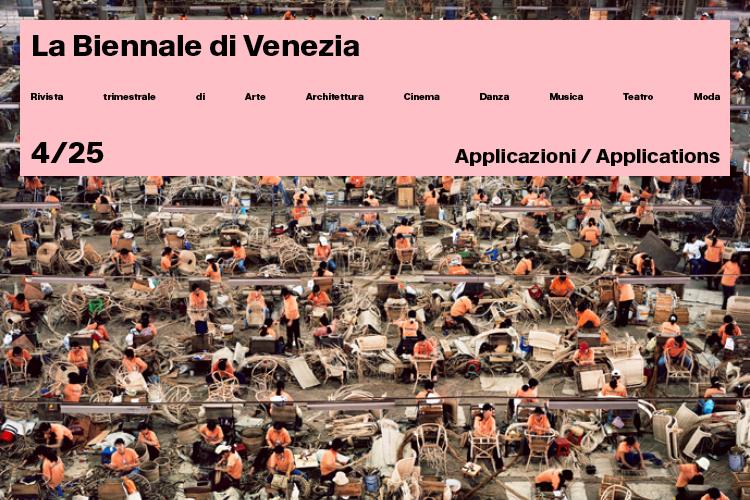
The cover features a chromogenic print by German artist Andreas Gursky, Nha Trang (2004), depicting scattered rows of women weaving bamboo chairs and baskets on the floor of an industrial warehouse in the coastal Vietnamese city of Nha Trang. The issue is also illustrated with photographic features by Iwan Baan, Michele Borzoni, Rachele Savioli, Matteo De Mayda, Alessio Miraglia, Antonio Biasiucci, Daniele Borghello, Martino Gamper, and Lorenzo Castore.
The voices of Issue No. 4/25 include: Luigia Lonardelli, Umberto Eco, Massimo Sterpi, Stefano Micelli, Brendan Cormier, Diane De Clerq, Daniele Torcellini, Âniko Ferreira da Silva, Giuseppe Donnaloia, Pavlos Mavromatidis, Marco Santi, Stefano Salis, Lilli Hollein, Virgilio Villoresi, Giovanni Leone, Yervant Gianikian, Giovanni Bonotto, Father Simone Raponi, Fuyumi Namioka, Francesca Ummarino, Stefano De Matteis, Elias and Yousef Anastas, Marta Cuscunà, Deyan Sudjic, Bjarke Ingels, Tim Reeve, Elisabeth Diller, Álvar González-Palacios, Julio Luzán, and Julian Schnabel.
The project
Conceived and produced exclusively in print format, the Magazine is distinguished by a rich iconographic apparatus, largely drawn from the Historical Archive of La Biennale and from photographic research conducted nationally and internationally. Published quarterly, each issue is devoted to a monographic theme, placing in dialogue the disciplines that characterise La Biennale di Venezia — visual arts, architecture, dance, music, theatre and cinema — together with incursions into science, literature and fashion. The Magazine hosts essays, testimonies, interviews, dialogues and unpublished and exclusive contributions by artists, scholars and prominent figures from the cultural sphere and civil society, both Italian and international. A multiplicity of languages and expressive freedom characterise each page, with ample space for graphic experimentation and cross-fertilisation between different forms and codes.
The Editorial team
Editorial Director: Debora Rossi. Director: Luigi Mascheroni.
The Editorial Board is composed of the Editorial Activities Office, the Press Offices and a team of professionals from the various Departments of La Biennale.
Graphic design: Tomo Tomo, a communication design studio founded in Milan by Davide Di Gennaro and Luca Pitoni.
distribution
The magazine is on sale on La Biennale’s online store and in leading Italian and international bookshops.
Previous numbers
No. 1/24 – Diluvi prossimi venturi / The Coming Flood
Contributions by: Manal AlDowayan, Engin Akyurek, Carlo Barbante, Davide Brullo, Carolyn Carlson, Aziza Chaouni, Giovanni Lindo Ferretti, Giulia Foscari, Chiara Ianeselli, John Kinsella, Piersandro Pallavicini, Francesco Palmieri, Gilda Palusci, Orhan Pamuk, Mariagrazia Pontorno, Elena Pettinelli, Andrea Rinaldo, Emanuele Rosa, Stenio Solinas, José Tolentino de Mendonça, Lorenzo Toso, Luciano Violante, Peter Weir, Kongjian Yu. The cover features a photographic image by Yuri Ancarani created during the filming of Atlantide. The volume is illustrated with photographs from the Historical Archive of La Biennale and by Chiara Arturo, Alessandro Cinque, Antonio Martinelli, Paolo Pellegrin, Italo Rondinella, Paolo Verzone, Federico Vespignani and Francesco Zizola.
N. 1/25 - La forma del caos / The Shape of Caos
Contributions by: Adonis, Matteo Al Kalak, Eleonora Barbieri, William Basinski, Cesare Bisantis, Boris Behncke, Sue Black, Irene Boyer, Silvia Calandrelli, Edoardo Camurri, Mircea Cărtărescu, Maud Ceriotti Giaccari, Roberto Cicutto, Giuseppe Conte, Maria Cristiana Costanzo, Pablo Delano, Okwui Enwezor, Marta Franceschini, Alessandra Iadicicco, Gianfranco Linzi, Giulio Maira, Alberto Manguel, Pablo Maurette, Damiano Michieletto, Paolo Nori, Federico Pontiggia, Mariagrazia Pontorno, Carlo Ratti, Amerigo Restucci, Bruno Ruffilli, Debora Rossi, Wang Shu e Lu Wenyu, Gian Antonio Stella. The cover is illustrated with a photographic image of Archèus. Labirinto Mozart, an immersive installation by Ophicina and Damiano Michieletto. The issue is illustrated with photographs from the Historical Archive of La Biennale, the Luciano and Maud Giaccari Archive, the Bergman Center Foundation, Getty Images and the Warburg Institute. It also includes photographs by Iwan Baan, Giacomo Bianco, Antonio Biasucci, Frankie Casillo, Giacomo Doni, Thierry Du Bois, Charles Fréger, Mary Gelman, Roberto Marossi, Domingo Milella, Alessandro Scotti, Giovanna Silva, Dayanita Singh and Gerald Ulmann.
N. 2/25 - Anteguerra / Things to Come
Contributions by: Christine Macel, Germaine Acogny, Roberto Cremascoli, Gianni Forte, Mazen Khaled, Luigi Gallo, Luca Francesconi, Antonio Marras, Darco Pellos e Wael Shawky, Josep Oriol Esteve, Claudio Magris, Robert Jan van Pelt, Mizue Hasegawa, Annarita Colombo, Jon Padfield, Javier Cercas, Gohar Dashti, Balakrishnan Rajagopal, Anita Likmeta, Valentina Tanni, Silvano Tagliagambe, Felix Azhimov, Giovanni Caprara, Cinzia Zuffada, Pier Luigi Sacco, Matt Leacock, Krystian Lupa, Stefania Vitulli, Alexander Sokurov, Denis Brotto, Mark Salvatus. The cover features a work by Mino Maccari: the image of the stage panel with a reflected face created for the final parade of the opera Commedia sul Ponte by Bohuslav Martinů at the 1951 Biennale Musica (tempera on plywood). The issue includes photographs from the Historical Archive of La Biennale, the Cinema Photographic Archive, Sfeir-Semler Gallery, Lisson Gallery, Lia Rumma, Barakat Contemporary, the Museo Nacional del Prado, Scala, Florence, New Picture Library, Summerfield Press, Carlo Valsecchi, the Maramotti Collection, Elvert Bañares, and the National Commission for Culture and the Arts (NCCA) – Philippine Arts in Venice (PAVB). It also features photographs by Stefano Graziani, Junpei Katayama and Jon Padfield, Carlo Valsecchi, Gohar Dashti, Luca Capuano, Lorenzo Pesce, Gabrielle Traversat, Toni Fabris, Joan Fontcuberta, Jason Larkin and Masahisa Fukase.
N. 3/2025 - Materia Prima / Raw Material
Contributions by: Maurizio Ferraris, Massimo Cacciari, Giorgio Marengo, Damiano Michieletto, Cesare Bisantis, Oge Obasi, Antony Hamilton, Xu Jiang, Michelangelo Frammartino, Luca Buoncristiano, Massimo D’Anolfi, Bruce Sterling, Raqs Media Collective, Daniele Cassioli, Giovanni Agosti, Giuseppe Bartolucci, Piero Genovesi, Pietro Li Causi, Davide Brullo, Hugo Mujica, Gino Gerosa, Vincenzo Milanesi, Arthur Duff, Arcangelo Sassolino, Alberto Biasi, Debora Rossi, Erzë Dinarama. The cover is by the artist Mari Katayama, featuring the work on the way home #005 (2016), while the back cover presents leave-taking #013(2021), also by Mari Katayama, who took part in the Biennale Arte 2019. The issue is further illustrated with photographs from the Archive of the Teatro Stabile di Torino, the Cinema Photographic Archive, the Theatre Photographic Archive, Flowers Gallery, Studio Ancarani, ZERO…, and Isabella Bortolozzi Galerie. It also includes photographs by Ela Bialkowska – OKNO Studio, Massimo D’Anolfi, Davide Ferrante, Pieter Hugo, Nadav Kander, Michele Palazzi, Pamela Randon, Italo Rondinella, Martin Usborne and Michael Wolf. Illustrations are by Lorenzo Mattotti.
historical notes
The Biennale di Venezia magazine 1950-1971
In consideration of the great success of the XXIV International Art Exhibition of La Biennale in 1948, the first after the end of World War II, the Institution decided in the early months of 1950 to publish a magazine with the intent to make it the official organ for the promotion of its events. The idea was to create a quarterly magazine titled ‘La Biennale di Venezia’. The cover image varied for each issue in relation to the activities of La Biennale, and from the very outset the magazine appeared as a precious object, printed in a large format, and highly refined from an editorial point of view: it featured inserts on different types and weights of paper, with many sophisticated images, mostly in black and white, but with some colour plates that increased in number over time. The initial title was: La Biennale di Venezia. Quarterly magazine of art cinema music theatre fashion. The inaugural issue was launched in July 1950 and consisted of 50 pages of text, 5 colour plates and 65 plates in black and white. The publisher was Vittorio Alfieri, Florence, the printer, Carlo Ferrari, Venice. The Editorial Board consisted of the President of the La Biennale Giovanni Ponti, the Secretary General Rodolfo Pallucchini, the editor-in-chief of the magazine was Elio Zorzi (head of the Press Office) who relied on the following collaborators: Umbro Apollonio (head of ASAC), Antonio Petrucci, Giovanni Piccini, Adolfo Zajotti, Ferdinando Ballo.
Second phase of the magazine 1960-1971
The double issue number 36/37 July-December 1959 was the last in a phase of transition. Pallucchini had left his position at La Biennale in 1957 and been replaced by Gian Alberto Dall’Acqua. Apollonio took over the magazine as editor-in-chief, and was officially appointed to the position in 1958, working from the start in close understanding with Wladimiro Dorigo. The less-academic orientation introduced by Apollonio tended to give space to the concerns of the art of the new generations, further updating the magazine’s look to make it less slick. The turnabout became evident starting with issue number 40 July-September 1960: the font was changed again, the number of critical contributions increased, the images were mostly in black and white.
The new policy sought to give “ample margin to the most pressing criticism in a union of formal, historical and aesthetic aspects which today’s global art proposes and develops”. It was also decided that the magazine would be published in-house by La Biennale, without involving other more or less renowned publishers, due to the lacklustre sales. This editorial policy remained in place through the 1970s, when after 1975 the publication of the magazine was replaced by that of the Annuari directed by Dorigo.