| Year and length: | 2025, 65’ (Italian premiere) |
|---|---|
| By: | Taxiarchis Deligiannis, Vasilis Tsiouvaras |
| Direction: | Christos Stergioglou |
| Original music: | Alex Drakos Ktistakis |
| Dramaturgy consultant: | Eleni Spetsioti |
| Movement supervisor: | Zoe Chatziantoniou |
| Set design & costumes: | Ioanna Tsami |
| Light design: | Eliza Alexandropoulou |
| Sound design: | Nikos Kollias |
| Audio monitor: | Sotiris Ziliaskopoulos |
| Direction assistants: | Taxiarchis Deligiannis, Vasilis Tsiouvaras |
| Costume assistants: | Maria Alexandrou, Dimitra Stavridou |
| With: | Christos Stergioglou (performance, voice), Georgios Iatrou (performance, voice) |
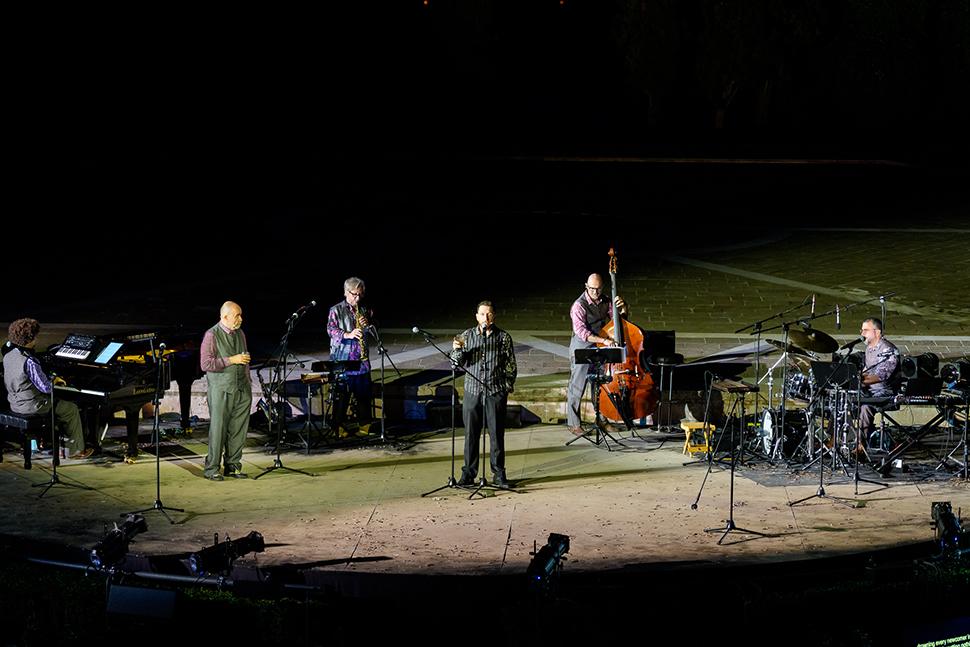
| Music performed live by: | Alex Drakos Ktistakis (percussion, electronics, keyboards), Giorgos Georgiadis (double-bass), Yiannis Papadopoulos (piano) Dimitris Tsakas (flute, sax) |
| Executive production: | Lykofos Productions |
| Production: | Athens Epidaurus Festival |
Theatre
Christos Stergioglou, Alexandros Drakos Ktistakis - Cries
Description
Cries gives voice to human suffering, to all those who have experienced slavery, uprooting and migration across the centuries, drawing on poetry and theatre, both ancient and modern: from the thought of the refugee in Giorgos Seferis to the lament of Hecuba in Euripides’ The Trojan Women, as well as Bertolt Brecht, Manolis Anagnostakis, Nikos Vrettakos, Warsan Shire, among others.
These texts and words—collected by Taxiarchis Deligiannis and Vasilis Tsiouvaras—form part of a collective memory that interlaces in a continuous flow with the original music of Alexandros Drakos Ktistakis, performed live by his ensemble together with the voices of baritone Georgios Iatrou and actor and director Christos Stergioglou.
“A music-theatre event that the audience is invited not merely to watch, but to experience and attune to a pulse that traverses the centuries, a pulse that is profoundly human, where ritual meets experimentation, where history is not re-enacted but reactivated, and where ancient forms do not find a conclusion, but are set free,” as Stergioglou says.