Tijuana is a young, fast-growing city that has become a major hub for migration as people from across the globe find themselves transiting through it in the pursuit of an American Dream. But because of its geographical location, it’s a city often misrepresented in film, usually shrouded by a violent lens far removed from reality.
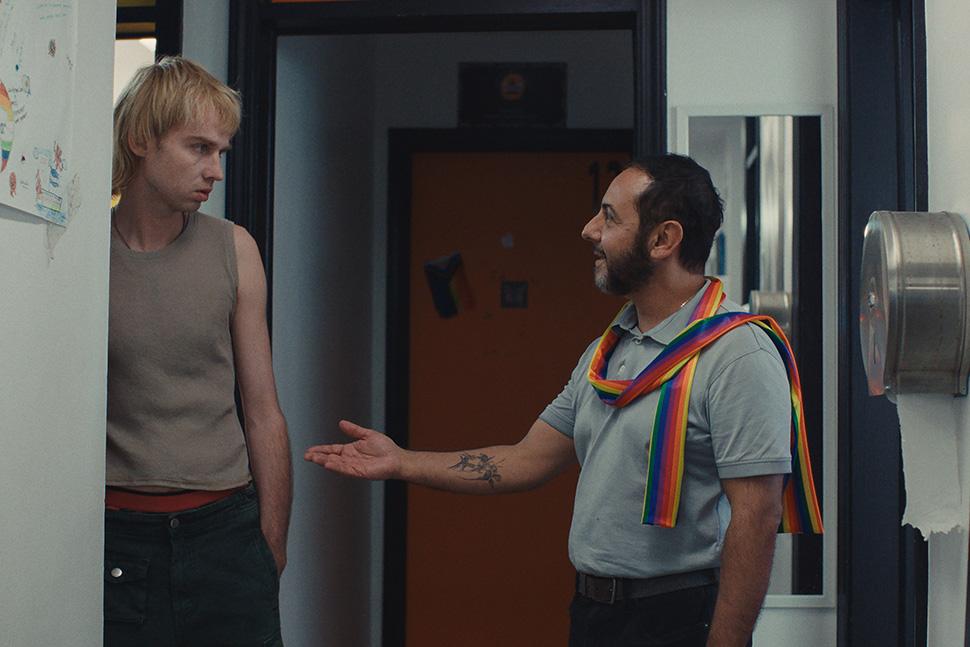
It has been one of my goals to depict Tijuana through my own interior and foreign understanding of it. Drawing from my experiences and concerns as a queer immigrant, Tijuana, todavía naturally became the story of two men finding each other in medias res of their emotional development while stranded at the border. Their story, to me, exemplifies our human ability to create meaning on the land where we’ve come undone. I see myself in Chava, who could only come to be through Humberto’s physical and emotional manifestation, and his encounter with Maksim, likewise inspired by a younger self; with additional inspiration borrowed from my dear friend Anatoly Fedorov, who, just like Maksim, fled Saint Petersburg after the war with Ukraine began.
In the film, digital communication is more than a narrative device: it becomes an essential, lived-in space. The film, told through the intertwined lives of Chava and Maksim, aims to explore a new landscape in queer cinema set in Mexico, where our stories are often reduced to stereotypes or conventions of trauma. As a forward step towards reinvention, our proposal is to explore our shared afflictions through the ways we transform them, for growth, for love, and for the desire to continue being.