Music -
Biennale Musica 2026: A Child of Sound
Sunday 11 October: Heaven Is Ours / O céu é nosso, celebration of the Brazilian culture of baloeiros (Sala d'Armi E, 11 am - 6 pm); Laraaji, laughter meditation workshop (Sala d'Armi G, 12 noon); Zwerm XL plays Gigi Masin and ML Buch (Sant'Elena, 6 pm); live sets with Alys(Alys)Alys / Mechatok & Armature Globale / Dj Anderson do Paraíso (Teatro alle Tese, 9 pm).
A Child of Sound
A Child of Sound is the title chosen by the Director Caterina Barbieri for the 70th International Festival of Contemporary Music to be held in Venice from 10 to 24 October. “Music is the childhood of the spirit: an experience that reconnects to a primordial state of openness, vitality and creative power. The grace of the child who looks at the world with the awe of his first gaze, or rather his first listening, with respect for its mystery, is the same grace with which music disarms us. One of the central figures of the European avantgarde, Karlheinz Stockhausen, frequently linked musical experimentation to the child’s capacity to play with sound, repeatedly asserting that the musician must maintain a mode of listening similar to that of a child: a virgin, non-judgmental listening, free of stylistic expectations or cultural conventions: childhood is thus the place of origin for radical listening”.
Drawing inspiration for the child of sound as a symbol of both revolution and healing, Biennale Musica 2026 presents a programme of world premieres and site-specific works that involve some of the interesting, innovative and multiform voices in contemporary music, beyond every rigid distinction of genre, era and style, in keeping with the curatorial approach undertaken last year. The programme includes many original commissions and collective works, which explore dynamic and participatory modes of listening.
The programme:
130 artists, over 40 events and 23 new works
130 artists – for over 40 events with 23 new works, 18 of which are world premieres – will be presented at the 70th International Festival of Contemporary Music, the protagonists in a programme that travels across the centuries and continents mixing tradition, classical and experimental.
The Parco della Musica Contemporanea Ensemble, 32 instrumentalists and a 16-voice choir conducted by Tonino Battista, combines the world premiere performance of Musica per una fine by Ennio Morricone, a previously unreleased work published posthumously by Sugar Music and built around a poem by Pier Paolo Pasolini read by the poet, with a programme of music by Johann Sebastian Bach, which includes the Ricercar a 6 in the masterful orchestration by Anton Webern, and a commission to Sarah Davachi, one of the most compelling and coherent voices on the contemporary music scene, who will receive the Festival’s Silver Lion. Sarah Davachi will also make her debut in a recital for solo chamber organ that will alternate pieces from a new album to be released next summer and pieces from the 2024 album The Head as Form’d in the Crier’s Choir.
A new piece commissioned by La Biennale to be presented in its world premiere performance, is a transcultural work that sets up a dialogue between the American composer and vocalist Lyra Pramuk and the Iranian musician Mohammad Reza Mortazevi, one of the leading performers of traditional Persian percussion, the technique of which he has radically redefined. The futuristic vocal incantations that Lyra Pramuk is famous for, in which many have seen an affinity with Meredith Monk and Cathy Berberian, are the starting point for exploring electronic layering and avantgarde techniques through which to reinvent timeless folk traditions. With them the Egyptian multi-instrumentalist El-Ghazouly on the Moroccan sinter, Slovakian fujara and electronics.
From Lyra Pramuk’s prodigious vocals to the deeply stirring power of a cappella singing by the Tallis Scholars, who have been performing the great Renaissance and Baroque sacred vocal repertoire for over fifty years. Chants, as the concert is titled, is a musical journey across the centuries, from the High Medieval to the contemporary age, united by a shared aspiration toward song as a privileged path of spiritual elevation. A programme of antiphons, responsories, hymns and sequences in which singing becomes an instrument of prayer, healing and mystical union with God: from Hildegard von Bingen and Gregorio Allegri to Arvo Pärt and Kara-Lis Coverdale, from whom La Biennale commissioned the creation of a new piece that will premiere at the Festival. A pianist and organist, as well as a composer and musicologist, Kara-Lis Coverdale, the Canadian artist of Estonian origin, while rooted in a contemporary sensibility, draws from the Baltic choral tradition, placing the voice at the centre of her work. The composer will also be at the Biennale in the role of performer of her latest album Changes in Air, which explores electronics, acoustic instruments and the organ. Joining her on the stage as the guest organist will be Sarah Davachi, winner of the Silver Lion.
Canons for a cappella choir by Clarissa Connelly, in its Italian premiere performance, again centres on the voice to explore the complex relationship between historical memory and the contemporary world. A Scottish composer and multi-instrumentalist based in Copenhagen, in her works, suffused with a mystical breath, Clarissa Connelly creates a dreamlike synthesis between Nordic folk songs, Medieval song and digital sounds.
ONCEIM, the Orchestre de Nouvelles Créations, Expérimentations et Improvisations Musicales, founded in Paris in 2012 by the composer and conductor Frédéric Blondy and dedicated to contemporary experimental electroacoustic music, will be at Biennale Musica with two Italian premieres. A creation for orchestra by Ellen Arkbro, a piece at the intersection between traditional acoustic instrumentation and electronic expansion, written music and improvisation, and Non puoi contare l’infinito for large ensemble, three voices and electronics, commissioned by the Philarmonie de Paris to Caterina Barbieri.
Complementing a musical tradition passed down through the centuries, is the effervescence of the hyper-contemporary Singeli music scene, one that also emerged peripherally to the mainstream and is the expression of an authentic cultural movement. It is the fastest electronic music, exploded over the past decade. Springing from the energy and vitality of the youth in the ghettos of Dar es Salaam and the coastal area of Tanzania, it is performed with an essential instrumentation, which might look “poor” – a laptop, mouse and Bluetooth – compared to the rich and sophisticated audio mixers of a dj set. With its distinctive vertiginous rhythms, relentless digital beats and rapid texts in Swahili steeped in social criticism, Singeli has developed a unique sound identity, which resonates deeply with the country’s youth. In Venice for a unique event, the protagonists of this scene: Hamadi Hassani, alias Dj Travella and Jay Mitta.
From the sound born in the peripheries of Tanzania to the original mix between electronics and the Afro-diasporic influences of kuduro, batida and gqom – the communal expression of the descendants of the former Portuguese colonies in Africa who have found their ideal fertile ground in the bairros of Lisbon and its melting pot. With Nídia, Dj Firmeza and Helviofox, the evening is conceived in collaboration with Príncipe, the record label founded in Lisbon in 2011 and dedicated to promoting the contemporary dance music born in the city’s suburbs and working-class districts, bringing a deep social and communitarian commitment into the work of its local artists.
In the space between popular and cultured music lies the experimentation of Walter Zanetti, who brings Cantos Yoruba de Cuba and El Decameron Negro to Biennale Musica.
The Cantos Yoruba de Cuba represent a remarkable exploration of Afro-Cuban sacred music, translated through the timbral intimacy of classical guitar. Basing his work on the compositions of the Cuban guitarists and composers José Angel Navarro and Hector Angulo, Zanetti recreates the spiritual essence of the batà songs of the Santería, the Afro-Cuban syncretic religion. His arrangements preserve the ritual meaning of the original batà rhythms while revealing new harmonic and melodic possibilities inherent to these ancient songs.
El Decameron Negro, built around a collection of African folk tales collected by the German anthropologist Leo Frobenius in the early 1900s, is considered one of the greatest compositions for classical guitar. The work of the most important Cuban composer, conductor and himself a consummate guitarist, Leo Brouwer, now 87 years old, El Decameron Negro dissolves into new melodies the folk and cultured music, rhythmic figures, ritual dances and songs drawn from his Afro-Cuban roots and avant-garde experimentation.
One of the most popular of instruments, which transcends the long tradition of cultured music to become the protagonist of so many musical revolutions of the twentieth century, the guitar will be the focus of a special Biennale Musica event. A guitar ensemble will perform music commissioned by La Biennale to ML Buch and Gigi Masin.
The Danish guitarist, composer and producer Marie Luise Buch, AKA ML Buch, born in 1987, is one of the fastest rising voices on the music scene for her particular experimentalism, which blends electric guitar, synthesiser and electronics. ML Buch will also be on stage personally for a live performance at the festival.
Venetian musician Gigi Masin, born in 1955, is an unusual figure in the Italian musical landscape. He has travelled the world over across his forty-year career, pursuing a solitary and coherent search. The author of instrumental music characterised by a personal minimalism that intersects electronics and electroacoustic, Masin will present Wind, an album he self-produced in 1986, which years later has become a cult album, and will be re-released in a new special edition to celebrate the fortieth anniversary of his debut, in October 2026.
Another cult album and recording adventure: Prati Bagnati del Monte Analogo by Francesco Messina and Raul Lovisoni, produced by the fertile avant-garde breeding grounds of Cramps Records in the late 1970s, for a series curated by Franco Battiato. Created within the framework of the electronic experimentation of the time, over the years the album has gathered a growing cult following, to the point that it was reissued in 2013 by Die Schachtel. Inspired by the unfinished surrealist novel Le Mont Analogue by René Daumal, the album brings to life a collection of delicate melodies and subtle harmonic interplay that embody several creative traditions. In addition to the presentation of Prati bagnati del Monte Analogo, specially rearranged for the occasion by Francesco Messina in a version for trio (piano, cello and synthesisers), the Italian composer will also present new pieces under the title Le api dell’invisibile for their world premiere performance at the Festival.
Also at the Biennale will be two new voices of Italian synthetic minimalism, Marta De Pascalis and Grand River, making their world premiere debut at the Festival. The creator of experimental electronic music with hypnotic stratifications and repetitive patterns that build dense sonic landscapes, Marta De Pascalis will present a new work for synthesisers and tapes. The work of Grand River (a pseudonym for Aimée Portioli), influenced by minimalism and ambient music, incorporates a wide range of contemporary composition and production techniques, combining modular synth, acoustic sounds and environmental recordings. Grand River will present the world premiere of her new album for guitar and electronics to be released by the historic avant-garde record label Editions Mego.
Alongside these new voices, seminal figures such as the 82-year-old American artist Laraaji, one of the brightest and most singular figures in ambient and contemporary new age music, who will come to Biennale Music with one of his spectacular live performances and a workshop on meditative laughter. He trained as an actor, comedian and classical musician before being discovered by Brian Eno in the early 1980s, and becoming a crucial figure in the field of ambient music, while continuing to expand his creative universe through performances, meditative laughter workshops and transversal collaborations. His compositions for electric zither and prepared instruments seem suspended in a timeless dimension in which scintillating and dilated vibrations create sonic landscapes of ecstatic calm.
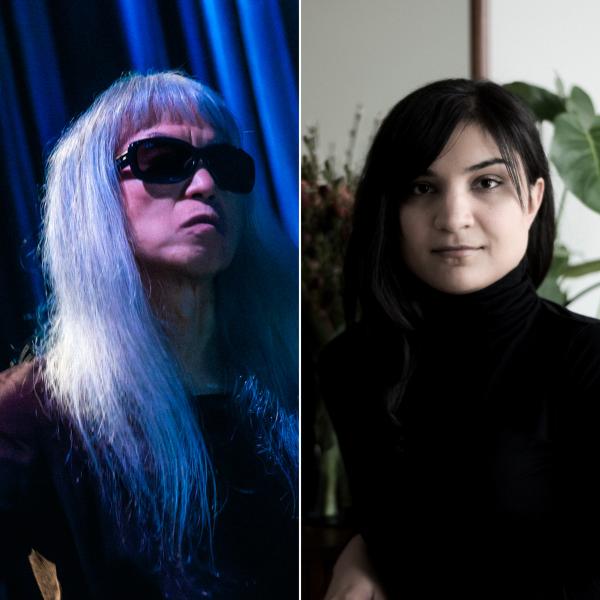
Another master, a pioneer of the Japanese noise scene and cult figure of radical improvisation is Keiji Haino, the Golden Lion for Lifetime Achievement. For Biennale Musica, Haino will give a site-specific concert for voice and string instruments, and will also present a documentary about his career, directed by Kazuhiro Shirao, which has never been shown outside Japan. Keiji Haino’s musical poetics, in which spontaneous performance takes on an essential value and becomes an embodied act of freedom and absolute radicality, finds deep resonance with the theme of the Festival.
A multisensory performance, As Nature was conceived by Kenyan musician KMRU, and developed together with the artists Nick Verstand and Mareike Bode. The artist’s attention to electromagnetic sounds and their humming is transformed into ample sonic landscapes that give life to a profoundly meditative study of noise. The sonic dimension interweaves with visual and olfactory stimuli, offering an experience that involves and suspends the senses in a continuum of subtle and richly resonant perceptions.
Polygonia will present a DJ set moving fluidly between techno, bass music, breakbeat, house and other electronic genres. Combining intricate rhythmic structures with detailed sound design, the set draws together diverse musical influences.
Among the freshest and most adventurous voices in electronic languages tied to dub techno, will be British artist Carrier, known for his sculptural approach to the lowest frequencies of sound, Loidis, the most recent alias of American artist Huerco S., who will present a new live set dedicated to his characteristic sounds on the edge between dub techno, experimental ambient and low-fi house, and the young Afro-American dj Liwvutang, alias Olivia Klutse.
Biennale College
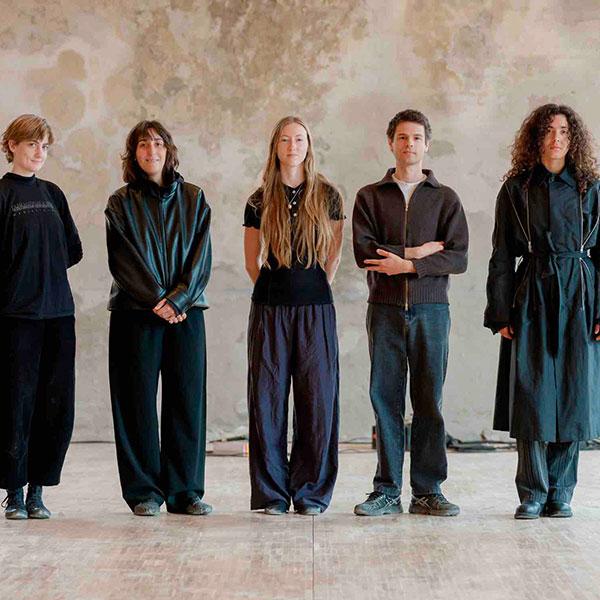
The five young musicians – composers, sound artists or performers – under 30 selected by the Director Caterina Barbieri for Biennale College hail from Canada, the United States, Brazil, Italy and Portugal. They are Wyldie Bracewell, Talullah Calderwood, Lara Dâmaso, Andrea La Pietra, alys(alys)alys (the alias for Alanis Todeschini Marca).In keeping with this year’s theme, the young musicians will develop their own projects for live performances, acousmatic composition, or audiovisual installations over the span of three residency sessions in Venice – in April, June and September – following a programme of inquiry, research, creation and production to be held in Venice under the guidance of internationally renowned musicians and experts. The mentors will include: Lyra Pramuk, Miller Puckette, Simone Trabucchi, alias STILL, Thierry Coduys, Moor Mother, Marcel Weber, alias MFO, who will also author the sets and lighting design of the entire Festival.
The projects developed in the course of Biennale College will be presented in their final form during the Festival.
In the Sale d’Armi at the Arsenale, in keeping with the concept of the LSD Centre at last year’s edition, a space will be specifically dedicated to deep listening, encounter and exchange, titled, in keeping with this year’s theme, Origine. The programme will include live concerts, listening sessions, screenings and encounters, with the participation as well of Masaru Hatanaka from the legendary Nightingale listening bar in Tokyo, who will curate the musical and visual selections.
The spaces
This year again, the live performance arts festivals will involve the assigned spaces in Venice and other new ones, and will extend to Mestre and Marghera, involving the territory of the Venetian mainland in its most vital areas.
Shows, concerts and many of the events in the programme will take place in the unique spaces of La Biennale di Venezia at the Arsenale (Teatro alle Tese, Tese dei Soppalchi, Sale d’Armi, and Teatro Piccolo Arsenale); in the headquarters at Ca’ Giustinian; in the historic theatres of the city, Malibran and Goldoni.
A new feature this year is the presentation of a Biennale Teatro concert production (Cries by Christos Stergioglou and Alex Drakos Ktistakis) at the Teatro Verde on the Island of San Giorgio Maggiore, the splendid open-air amphitheatre restored to the city by the Fondazione Giorgio Cini in 2022. Whereas the play by Davide Iodice, Promemoria, will be performed in the places in which it was created, at the Centro Servizi di San Giobbe with its residents. Like last year, the opening of Biennale Musica will feature an ensemble of young guitarists winding their way through the streets and squares of Venice, while other events will be hosted at Forte Marghera and the Parco Albanese in Mestre, spaces that are now part of the city’s cultural landscape.
Educational
Over time, La Biennale di Venezia has developed a strong commitment in the field of education with their Educational activities, addressed to the audiences of the Dance, Music and Theatre Festivals. They have worked with universities, schools, families, a public of enthusiasts and the merely curious, involving over 68,000 people in more than twenty years.
All the initiatives are aimed at actively involving the participants and are led by professional staff members selected and trained by La Biennale. They are divided into workshops, open classes, interdisciplinary activities, interactive learning initiatives.
Podcast
La Biennale on Air is the official podcast of La Biennale di Venezia, launched in September 2025 and available on the major platforms (Spotify, Apple Podcasts, Amazon Music, YouTube) and on La Biennale di Venezia’s website.
The new March 2026 episode will be available starting on Wednesday, March 25th and will feature contributions from Mamela Nyamza and Sarah Davachi, the Silver Lions of Biennale Danza 2026 and Biennale Musica 2026, and Emma Dante, recipient of the Golden Lion for Lifetime Achievement for Biennale Teatro 2026, Laurie Anderson, American artist and musician invited to the Biennale Arte 2026, Mona Fastvold and Amanda Seyfried, respectively the director and lead of the film The Testament of Ann Lee, presented at the 82nd Venice International Film Festival.
Catalogues
The official catalogues of the 54th International Theatre Festival, the 20th International Festival of Contemporary Dance and the 70th International Festival of Contemporary Music are published by La Biennale di Venezia and edited by the Directors of the three Departments. The three catalogues will explore the themes, protagonists and productions of each Festival and feature critical essays, images and original illustrations.
The graphic identity of the Dance Music and Theatre Department is designed by studio Headline in Rovereto, as is the layout of the catalogues for Biennale Danza 2026. The layout of the catalogue for Biennale Musica 2026 and Biennale Teatro 2026 is designed by Studio Tomo Tomo in Milan.
La Biennale di Venezia’s commitment to environmental sustainability
Since 2021, La Biennale di Venezia has launched a plan to review all of its activities in light of recognized and consolidated principles of environmental sustainability. From 2022 to 2024, La Biennale has obtained carbon neutrality certification in accordance with the PAS 2060 standard for all its events held throughout the year, thanks to data collection on the sources of CO₂ emissions generated by the events themselves and the implementation of consequent measures. For the year 2025, the goal was to obtain certification for the calculation of the carbon footprint, in accordance with the new ISO 14067 standard, for all of La Biennale’s scheduled activities. In this sense, La Biennale will engage again in 2026 in a communication campaign to raise the awareness of the participating public.
thanks
Our thanks to the Italian Ministry of Culture for its important contribution and to the Veneto Region for its support of the programmes in the Dance Music and Theatre Sectors of La Biennale di Venezia.
Media partner of the Dance Music and Theatre Sectors is once again Rai. Through its information channels and Rai cultura - in particular the TV channel Rai 5 and Radio3 – the various activities taking place in Venice will be described and offered to the public.
Our consolidated collaboration continues with Vela – Venezia Unica, a commercial company of the City of Venice specialized in mobility and marketing, with an agreement of reciprocal promotion and visibility.
We thank the following for their collaboration: Comune di Venezia, Fondazione Forte Marghera, Fondazione Teatro La Fenice, Teatro Stabile del Veneto “Carlo Goldoni”, Fondazione Giorgio Cini, Centro Servizi San Giobbe, I.P.A.V. Istituzioni Pubbliche di Assistenza Veneziane.