La Biennale -
Theatre Dance Music 2026: the programmes
158 events and 470 artists onstage in Venice for the Theatre, Dance, and Music festivals that will run from June to October 2026.
Teatro Danza Musica 2026
This year La Biennale di Venezia opens its live performing arts season on 7 June with the 54th International Theatre Festival directed by Willem Dafoe on stage through 21 June; it continues from 17 July to 1 August with the 20th International Festival of Contemporary Dance directed by Sir Wayne McGregor; finally, the 70th International Festival of Contemporary Music directed by Caterina Barbieri will take place from 10 to 24 October.
158 events and 470 artists who will be in Venice for the Dance, Music and Theatre festivals: an overview of the world that involves countries from one part of the globe to the other – from Italy and the shores of the Mediterranean Sea to Lapland, from South Africa to the Chinese Daliangshan regions to Southeast Asia to Japan, Samoa and New Zealand. Around them the Biennale College community, the young artists under 30 venturing into the art world to bring their creations onto the international stage of the festivals. This year, 1841 applications to participate were submitted from 48 different countries: for the calls for Italian directors and playwrights, with in addition the new call for actors and actresses; for the calls for choreographers and dancers, with in addition the calls for new works by an Italian choreographer and a foreign choreographer; finally the call for composers, sound artists and musical performers. A commitment by La Biennale to provide the resources, time, methods needed to beget new long-term projects. But at the same time a contribution to the renewal of the idea of direction and dramaturgy, choreography and dance, musical composition and performance, an observatory onto the evolution of live performing arts.
As Pietrangelo Buttafuoco, President of La Biennale di Venezia, writes in his presentation:
“Dance, music and theatre are languages that manifest themselves in time and in presence, defining themselves in the relationship of the here and now between artist and audience. For Sir Wayne McGregor, dance invites us to reconsider the nature of time, for Caterina Barbieri music takes us back to the primeval listening from which everything arises, for Willem Dafoe theatre leads us back to the truth of human encounter. The titles they have chosen – Time Does Not Exist, A Child of Sound and Alter Native – are more than poetic statements, they affirm the here and now and stand as genuine orientations for our being in the world. And the three departments, once again, confirm the dialogue they have established between them, each with its own specific code. The programmes presented by the directors, in fact, explore the central dimension of the live artistic experience understood as a necessary medium to renew, time and time again, the perception of reality of those who participate in a performative event”.
Biennale Teatro
On stage from 7 to 21 June 2026, the 54th International Theatre Festival will bring to Venice over 200 artists for 55 events, including 11 productions and co-productions, 10 world premieres, 2 European and 4 Italian premieres. 610 applications were submitted for Biennale College Teatro.
“For this year’s edition – stated the Director Willem Dafoe – we chose the title ALTERNATIVE, or more precisely ALTER NATIVE. There is no specific meaning, because etymology can be vague or evocative. The idea is to think of ALTER as a change and NATIVE as one’s personal nature. Or ALTER as other and NATIVE as the culture of origin”.
The 54th International Theatre Festival spans all the continents, casting light on different alphabets, cultures and traditions, which do not faithfully reproduce themselves, but open new pathways, offering alternative ways of seeing and understanding the world.
The journey begins at the living origin of theatre, from the Greece of Christos Stergioglou and Alex Drakos Ktistakis with their music-performance Cries by Taxiarchis Deligiannis and Vasilis Tsiouvaras, “inspired by the refugee’s thinking of poet Giorgos Seferis, by Hecuba’s lament in Euripides’ The Trojan Women, and by the cries of all those who have endured slavery, uprooting and migration across the centuries”. Texts and words from a collective memory flow continuously together to the original music of Alex Drakos Ktistakis, on stage with his ensemble accompanied by the voices of baritone Georgios Iatrou and Stergioglou himself. A director and actor in theatre as well as cinema (he starred in Dogtooth by Yorgos Lanthimos and The Eternal Return of Antonis Paraskevas by Elina Psykou), multi-awarded Christos Stergioglou comes to Italy for the first time.
An exponent of new Greek theatre, Mario Banushi, winner of the Silver Lion, brings to the festival the trilogy that brought him instant fame, Romance familiare. Ragada, Good Bye Lindita, Taverna Miresia are the chapters in a landscape of memory that delves its roots in ancestral rites and traditions tied to Banushi’s childhood in Albania, a landscape built of poetic visions, evocative images suspended between dream and reality, charged with an emotional intensity that transforms intimate personal themes – relationships and affections, sense of loss and grief, nostalgia – into universal poetry. Mario Banushi’s trilogy will be presented by La Biennale di Venezia as a co-production of the Fondation Cartier pour l’art contemporain.
From Mediterranean Europe to the Far East, where for over thirty years Satoshi Myiagi, the student and heir of the master of Japanese experimental theatre Tadashi Suzuki, takes on the cornerstones of the Western theatre tradition, from Greek tragedy to Shakespearian drama (extraordinary his Antigone by Sophocles with which he inaugurated the Festival d’Avignon 2017), through the lens of traditional Japanese theatre, making them resonate in a new way. Thus Mugen Noh Othello, which he will bring to Biennale Teatro, reinvents Shakespeare in light of the ritual of Mugen-Noh theatre. One of the different categories of Noh theatre, dating back to the thirteenth century, Mugen-Noh conceives plays as the recreation of a dream or illusion within a unitary horizon in which the living and dead coexist. Myiagi transforms the tragedy of the Moor of Venice into a rêverie interpreted by the ghost of Desdemona, who relives the original cause of her suffering and shifts the fulcrum of the tragedy. A reinvention that brings tension to the distance between bodies and voices, between gesture and narration, entrusting each character to a dual performer.
From Southeast Asia, and more precisely from Sumatra, comes an original form of dance, music and song that draws from a traditional complex of martial arts, known as Silat, recognized in 2019 as an intangible heritage of humanity. The Bumi Purnati Indonesia company from Jakarta will present two productions: Under the Volcano directed by Yusril Katil, inspired by the terrible eruption of the Krakatoa in 1883, and Hikayat Perahu / The Tale of Boat directed by Sri Qadariatin, formerly an actress for Bob Wilson in I La Galigo and Persephone.
Inspired by the poem Lampung Karam, composed in the traditional Malay poetry form syair by Muhammad Saleh, a poet and religious scholar from Sumatra and eyewitness to the terrible event, Under the Volcano conveys a powerful and moving plot with simple stage props such as eight wooden sets of stairs used to recreate mountains, valleys and markets, as well as a montage of film clips and still images of fire, lava, rock. Hikayat Perahu / The Tale of Boat is inspired by a fundamental text in Malay literature, Syair Perahu, by the mystic Sufi poet Hamzah Fansuri, who lived between the sixteenth and seventeenth centuries. In the story of a boat that sails the Ocean the poet symbolises life and the spiritual journey the spirit undertakes toward God.
From India a performance art with a rigorous vocabulary, steeped in spirituality and refined eroticism, that has come down to us through the centuries: it is the Odissi dance of choreographer and dancer Sharmila Biswas from Kolkata, a student of the legendary master Kelucharan Mohapatra, before herself becoming a great internationally-renowned performer. In Venice, she will present Mischief dance: A Journey Through Rhythm and Spirit. Of the many different forms of Indian classical dance, Odissi arose as a devotional practice in the eastern central area of the country, and is danced to music that blends the Carnatic tradition of the south with the Hindustani tradition of northern India, alternating with dramatic texts drawn prevalently from the poem Gita Govinda.
Ancestral imagery consisting of earth and air, water and fire, inhabited by gods and men, provides the foundation for the visionary creations of Samoan artist Lemi Ponifasio, one of New Zealand’s major directors and choreographers, who draws from the aboriginal cultures of the Pacific – from the Maori of New Zealand to the Kiribati of Micronesia – as well as from South America to create, like a shaman, new symbols that also speak of our present, merging ceremonies, performative culture and contemporary theatre. Thus Star Returning: Venice, Ponifasio’s new work, is a way to listen to the earth, the ancestors and the shared myths of the Yi people from the mountainous region of Chinese Daliangshan, their cosmology, their origins and their deep bonds with nature, their ancestors and the spirituality innate in this culture.
The writer, actor, dancer and director from Rwanda Dorcy Rugamba has also worked with Peter Brook’s company, with Milo Rau and with Abderrahmane Sissako, the director of Timbuktu. Dorcy Rugamba will present the Italian premiere of Hewa Rwanda – Letter to the Absent, following its debut at the Théâtre des Bouffes du Nord and the Festival d’Automne, and a tour through the United States and Australia. Adapted from the eponymous work written by Rugamba in 2024 and translated around the world, Hera Rwanda – Letter to the Absent is a memoir to his own children, an eyewitness account of the genocide of the Tutsi perpetrated in 1994, which determined his story as a man and as an artist. On stage will be Rugamba himself with all the colours of the music by the eccentric and talented Senegalese polyinstrumentalist Majnun. “While Hewa Rwanda, Letter to the Absent addresses the genocide, questions of mourning and a family that was nearly annihilated, I primarily wanted it not to be a commemorative text but a hymn to life, so the tone of the text deliberately embraces lightness, humour, poetry, music and life in all its aspects”.
A world music celebrity, the singer Angelique Kidjo will be at Biennale Musica for a duo concert with pianist Thierry Vaton. Originally from Benin, but based for many years in France, Angélique Kidjo has created a common language between different cultures based on the legacy of western African traditions to incorporate elements from genres such as funk, jazz, soul, and influences from Europe and Latin America.
Turning the focus back on Italy, Emma Dante, the most celebrated Italian director of theatre and opera and the Golden Lion for Lifetime Achievement of this year’s Biennale Teatro, will present the world premiere of I fantasmi di Basile, taking on the visionary Baroque world of the Neapolitan writer Giambattista Basile, whose plays La scortecata, Pupo di zucchero and Re Chicchinella she had already directed. “I have always intercepted something real and contemporary in his tales, something that belongs to us – stated Emma Dante. Therefore, what I like about Basile is the truth. Despite the extraordinary architecture he builds through language, he always maintains something strongly realistic. In I fantasmi di Basile there are several fragments from our trilogy, which evoke the ghosts in the story”.
Following the critical and audience acclaim of his unorthodox Pinocchio, constructed with the “diverse” bodies of the kids from the Scuola Elementare del Teatro company in Naples, Davide Iodice returns to Biennale Teatro with Promemoria, a work in which he addresses the theme of memory, focusing on the stories and the lives of the elderly living in care facilities. Following a working method centred on the person and human frailties, Promemoria was conceived at the end of an intensive workshop titled L’enciclopedia delle Emozioni, which took place from 29 May to 2 June 2025, in the structures that care for the elderly in Venice. “An invitation to explore the transformative power of theatre and human relation, and to become part of a collective creative process addressed directly to the community” says Iodice. The outcome of this long process is Promemoria, a performance that will take place at the Venetian Public Assistance Institutions in San Giobbe.
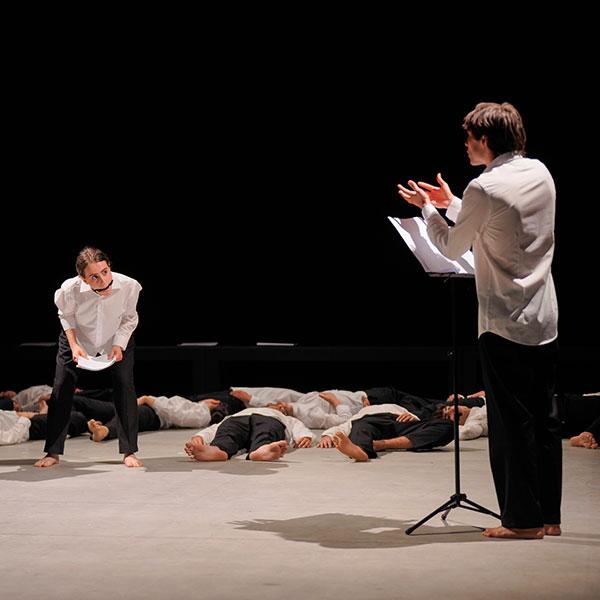
Attention to new creativity finds space at the festival in the consolidated activity of Biennale College, which once again this year presents a director and two playwrights under 30, selected through national calls and following several phases of evaluation. This year Alberto Colombo Sormani was selected to make his debut on the Festival stage with Imago Vocis | spacetime in-between, which weaves together his vocation for theatre with the study of astrophysics – he is a researcher in this field at the National Institute of Nuclear Physics of the Università La Sapienza di Roma – attention to new technologies and the language of the body. “A rare mix of ambiguity and daring. A far-sighted project” as Willem Dafoe defined it when selecting it.
Davide Pascarella and Bruna Bonanno are the winners of the two-year call dedicated to new dramaturgy. Bacio Sogno Autodistruzione, defined by its author as “the public performance of an intimate and private journey”, will be presented as a staged reading by Alessandro Businaro, who had previously participated at the Biennale with the production titled George II and was recently appointed junior artistic director of the Teatro Stabile del Veneto. “In its probing self-examination, in addressing the contemporary malaise gripping a generation, the work hints at a potential for growth that deserves maximum attention” – the motivation reads.
Aka Jolly Roger by Bruna Bonanno is a “pirate play” according to Motus, who in an exceptional departure from their artistic pratice, will author the mise en lecture of the text, drawn by the affinity they found in the “libertarian content and in the light that radiates from the text, in the very insistence (though the end seems ever closer) to imagine new forms of alliance/coagulation among resistant cells. But we are also fascinated by the “aquatic” structure of the writing, the idea of looking at our land from the sea: we embark on a pirate galleon, we sew its flag (a new variation of the hundreds of Jolly Rogers scattered around the world) to sabotage the very mechanisms of the mise-en-scene”.
Following its debut in the form of a staged reading last year, Tacet by Jacopo Giacomoni, the play that won Biennale College Dramaturgia 2024-25 and the Riccione Prize 2025, has been brought to completion and will premiere under the direction of Silvia Costa. A text inspired with originality by philosophy, metaphysics and mathematics, thinking of the last secular rite which is the minute of silence, that plays with the metronome in search of what it means to stand together in silence, inside a minute, inside a theatre”.
In the spirit of Biennale College, cultivating the relationship between young artists and mentors, the Schools of Theatre Project returns for a second year, with Biennale Teatro open its doors to three academies:
The Civica Scuola di Teatro Paolo Grassi, with the actors in their third year, will stage a classic by Brecht, Santa Giovanna dei Macelli, directed by Marco Plini, to understand how imbalances, inequalities and mechanisms of financial market manipulations change, shifting “the paradigm of conflict in an age that has superseded the concept of class struggle”.
The Accademia Teatrale Carlo Goldoni of the Teatro Stabile del Veneto – Teatro Nazionale, with the director Giorgio Sangati and the graduates of the acting course, presents an original dramaturgy by Stefano Fortin, Comeradovera. Weaving together stories, points of view, details, states of mind, times and memories, public and private experiences, around the fire that burned down the Teatro La Fenice thirty years ago, the work questions the relationship between the life of an individual or a community and the traumatic experience of loss.
Finally the Scuola Teatro di Napoli – Teatro Nazionale, with the director Arturo Cirillo and the young second-year actors, pays tribute to Enzo Moscato, a fundamental figure of Neapolitan dramaturgy who passed away two years ago, combining two plays from the 1980s, Festa al celeste e nubile santuario and Ragazze sole con qualche esperienza, which in the new production become Quindici ragazze con qualche esperienza.
Finally a new college for actors was introduced this year by director Willem Dafoe: the eleven performers under 30 selected from a list of 440 applicants will participate in a residency project in Venice, to take place over the span of four weeks – from 25 May to 21 June 2026. A series of workshops with, in addition to Dafoe, Evangelia and Mary Randou, Simon McBurney of the Théâtre de Complicité and Silvia Costa.
The mentor for the workshop organised for the first applicants selected for the new playwriting call of Biennale College will be the poet and playwright Fabrizio Sinisi.
There will also be a theatre criticism workshop, in collaboration with the teacher and critic Roberta Ferraresi and Massimo Milella; conversations, encounters, roundtable discussions with the artists will be conducted by Maddalena Giovanelli and Andrea Porcheddu, journalists and theatre critics.
A tribute to Bob Wilson will be on display in Sala delle Colonne at Ca’ Giustinian for the entire duration of the festival, exhibiting materials collected and preserved at ASAC, the Historical Archive of the Contemporary Arts of La Biennale di Venezia.
Biennale Danza
Taking place from July 17th through August 1st, the 20th International Festival of Contemporary Dance directed by Sir Wayne McGregor is titled Time Does Not Exist, inspired by the theories of the physicist Carlo Rovelli. “Rovelli’s ideas on the non-linearity and multiplicity of time – writes McGregor – have been at the forefront of my mind as I immerse myself in the history of Biennale Danza, which will mark its twentieth ‘official’ birthday in 2026. Systematically and chronologically revisiting the legacy, I reach back into the archive, attempting to rewind and reflect, extracting from history the figures, facts, and narratives of the past. An ephemeral jigsaw emerges, offering only a shadow of the embodied experiences of yesterday, but nonetheless one that I am grateful to touch. Again and again, the dancers, the choreographies, the concepts, the photographs, the artefacts, the knowledge, the intelligence coalesce, overlap, and superimpose out of time and out of sync with everything that surrounds it. This living archive creates a non-manifest body with a consciousness beyond—much wider than our self.
Then I realise that time does not exist and in some fundamental way, dance artists have always understood this, inviting us to feel a sense of wonder and curiosity about the nature of reality.
The artists in Biennale Danza 2026 are like (and unlike) our past dance time travellers who, in their own unique ways, explore and depict multiple timelines, perspectives, and realities through their work… This profound exploration of time, or rather a time that does not exist, at Biennale 2026 profoundly engages with themes of memory, identity, and existence, encouraging our audiences to reflect on and perceive their connection with their own lifetime – an invitation to changing relationships and states”.
Over 150 artists for over 60 events across the span of two weeks (17 July > 1 August) and a programme consisting entirely of new works: 9 world premieres, 3 European premieres, 8 Italian premieres. New works that express the evolution in the languages of dance, impelled by the urgencies of our time, languages regenerated by the vital energy of the cultures of origin of many of the artists present, deeply connected to the rhythms, landscapes, symbols and histories of other traditions channelled by the body. But the greatest success is the dense network of productions and coproductions initiated over the years by Biennale Danza, primarily by selection, renewing its commitment to the younger generations: 695 applications have been submitted for the calls promoting new choreographies nationally and internationally, along with 358 applications to participate in Biennale College Danza.
From the First Nations of Australia to South Africa, the Lions of Biennale Danza 2026 bring to Venice the Bangarra Dance Theatre (Golden Lion for Lifetime Achievement), the first company consisting entirely of Australian Aboriginal dancers, and the dancer, choreographer, director and activist Mamela Nyamza (Silver Lion) with her eponymous company. Both ensembles will make their debut with two European premieres: respectively Terrain, choreographed by Frances Rings, a production that evokes the power of the body and the earth, inspired by the timeless beauty of the largest salt lake in Australia, the Kati Thanda-Lake Eyre, and The Herd/Less, a work about the ambiguity of a wonderful world that evokes violence and vulnerability exploring the dual meaning of “herd”: the symbol of collective harmony, but also of control and submission.
A highly anticipated return to Venice and to the Biennale is that of Emanuel Gat, a leading figure in Israeli dance and one of the most beloved choreographers in Europe, where he has been based, in France, for twenty years. Five Days in the Sun, set to Mahler’s Fifth Symphony, is the new work that this artist, whose pure choreographic lines are modeled on musical composition, reserves for Venice together with a new ensemble of twelve dancers.
History and traumas are inscribed in the memory of the body with two artists who turn choreographic practice into a contemporary, poetic, political gesture. In its Italian premiere performance, What is War delves into the marks left by war on the body and the collective memory of the generations to come. On stage Eiko Otake, trained in Japan by the butoh masters Kazuo Ohno and Tatsumi Hijikata, who has worked in New York since 1976 and has presented her multimedia works around the world, and Wen Hui, the charismatic pioneer of modern dance in China, where in 1994 she founded the first independent company outside the state system, in Beijing, and is currently based in Frankfurt. Between new wars and global crises Wen Hui and Eiko Otake remind us how fragile, and how precious, every individual life is.
The body as a form of historical, social and political documentation is also expressed in Làhppon/Lost by choreographer and director Elle Sofe Sara, who finds her wellspring of creative energy in the Sami culture and in the totalizing nature of her native Fennoscandia, where Norway, Russia, Finland and Sweden meet. The work echoes and refracts in the present a critical episode in Sami history, the Kautokeino rebellion (1852) against the Norwegian authorities and the practices of forced assimilation, to reflect upon the human mechanisms of fear, injustice and hope. For the first time a Lappish artist, Elle Sofe Sara, together with the Icelandic choreographer Hlín Diego Hjálmarsdóttir, directs 19 of the 70 dancers in the corps de ballet of the Oslo Opera House, making their debut last year on the main stage.
Searching for a vocabulary that connects bodies and history, the children of the diaspora to their places of origin, the Franco-Malagasy choreographer Soa Ratsifandrihana, who studied with De Keersmaeker and Charmatz before founding the Kintana company in Brussels last year, literally strips away every academic tradition to reinvent her own buried roots. Fampitaha, fampita, fampitàna, which premieres in Italy, develops a collective approach to choreography, establishing a dialogue with narrative and music, together with four partners, three dancers and a musician, who represent the diaspora from Haiti, Martinique and Guadeloupe.
Omar Rajeh, a central figure in the diffusion and development of contemporary dance in Lebanon and in the Arab world, equally renowned in Europe where he has been based in Lyon since 2020, brings his latest work, Dance People, to the festival. Considered a milestone in an artistic career that dismantles hierarchies and power structures which standardise and discipline the body, Dance People asserts the aggregating and community-building value of dance, making it an act of highly political significancea. Rajeh reinvents theatre conceiving it as a shared territory of which the spectator is an integral part, free to move and shape the show together with the dancers. From an aesthetic of watching to an aesthetic of participation. Because Dance People is not a show to contemplate from afar, but a gesture to share, a space to inhabit.
The ephemeral art of dance, which is born, dies and perpetually renews itself within the circumscribed space of a gesture, is at the centre of the work of several companies invited to Biennale Danza.
Text, movement and hypnotic stage illusions in which time reverses, gravity disappears and the laws of nature dissolve, Tempo is the creation of Finnish artist Kalle Nio, who merges visual theatre, experimental cinema, contemporary circus and new magic, together with the Brazilian choreographer based in Sweden Fernando Melo. The Slovenian dancer and puppetmaster Barbara Kanc, the Italian dancer Luigi Sardone and the Swedish dancer and acrobat Winston Reynolds move across a landscape between dance, theatre and acrobatics.
Winner of the national call for a new choreography, Andrea Salustri draws from a transdisciplinary background that he puts to work in his productions, in which he shapes a world of objects to manipulate, transform and accompany with his body to reveal their secret vitality. After Materia, a pas-de-deux between body and object that fascinated the audiences of Biennale Danza 2023, in Invisible Salustri focuses on the intangible agents – air, light, smoke, wind, fog – to explore whether dance can be a way, for even just a moment, to make the invisible visible.
Winner of the international call, Oli Mathiesen, a New Zealander of Maori origin, moves across various disciplines – dance, theatre, cinema – in his practice as a performer and choreographer. In Venice he will present Just Between Me and Jesus, a work inspired by the clubbing culture and the liturgy that underpins it, with seven New Zealand (Aotearoa) dancers, highlighting shared rituals, devotion and a sense of belonging in an expression of collective euphoria.
Featured are many leading figures in dance from every part of the globe:
Adam Linder, an Australian working between Los Angeles and Berlin and the author of works that have been presented in theatre and exhibition spaces such as the MoMA in New York, previously appeared at the Biennale with the Sidney Dance Company. He returns to Venice with Drip Tekhne, conceived in close connection with the ten performers, in residency at the Royal Opera in Copenhagen, Dansk Danseteaters: an exploration of the evolution of the process that led our bodies to become technical instruments of dance.
Winndance, an acronym for When if Not Now, is a stellar gathering, a new ensemble from Stuttgart that brings together the finest names in dance over the age of forty and leading authors: John Neumeier, who rewrote the history of contemporary ballet with Kyliàn and Forsythe, with whom he trained at the school of Cranko, Imre and Marne von Opstal, associated choreographers at the Nederlands Dans Theater, following a lengthy career with the finest companies in the world, Rainer Behr, who worked with the masters of Tanztheater Susanne Linke and Pina Bausch, Javier de Frutos, one of the most influential Latin-American choreographers working in Europe, Omar Román de Jesús, the internationally renowned exponent of Puerto-Rican choreography. They will present the world premiere of the Scirocco project, two chapters in a dialogue: Death in Venice and Bridge of Sighs. The world class performers include Diana Vishneva, Silvia Azzoni, Kayoko Everhart, Mara Galeazzi, Silas Henriksen, Igone de Jongh, Marijn Rademaker, Oleksandr Ryabko, and Gil Roman.
The history-making American dancer and choreographer Molissa Fenley will be in Venice in a triple role. First and foremost as the author of the cult piece State of Darkness, a single dancer contending with an entire orchestra in Stravinsky’s Rite of Spring seen under a new light, in a performance by Cassandra Trenary, formely a prima ballerina with the American Ballet Theatre and now with the Wiener Staatsoper. Then as the author, and exceptionally once again as the performer of Bardo, the solo she conceived for Keith Haring on the tenth anniversary of the death of the artist, whom she valued as a friend, collaborating with him on several projects together. In the Tibetan tradition “bardo” indicates the liminal space between death and rebirth. Finally Molissa Fenley will be a mentor for the sixteen young dancers and two choreographers of Biennale College, for the production of a new creation that will have its world premiere at the festival.
Biennale College Dancers and Choreographers
Bringing young talents in contact with the great masters of dance, engaging with learning, training, mentoring, creation, is the heart of Biennale College. After Crystal Pite, William Forsythe, Xie Xin, Saburo Teshigawara, Simone Forti, Wayne McGregor himself, Cristina Caprioli and Sasha Waltz, once again the sixteen young dancers from around the world and the two young choreographers will be in residence at Biennale Danza 2026, participating in classes, workshops, repertory works and vitally, creating new works, guided this year by Molissa Fenley and Maxine Doyle.
Maxine Doyle is an independent choreographer and director. Since 2002 she has been a director-choreographer for Punchdrunk, with whom she co-directed the multi-award-winning Sleep No More (London, Boston, New York, Shanghai). As McGregor writes: “ Both singular artists are powerhouses of imagination, experience and innovation, and we are thrilled to be coommissioning two new works specifically for the dancers of Biennale College 2026”. In addition, the two young choreographers selected through the call will create and present world premieres at Biennale Danza 2026, guided by Wayne McGregor and his team.
20 Years of the Festival
Celebrating the twentieth edition of the Festival, Biennale Danza, created as an independent department twenty-eight years ago, tells its story in an exhibition, Life Lines, created in collaboration with the Historical Archive of La Biennale – ASAC. Through film, photographs, text, documents, objects and talks, this exhibition Life Lines “will captivate, inspire, and remind us that the body is a living archive, and the living archive is itself a body”.
Like every year, the Festival will hold laboratories for specialists that are also open to the public, featuring many of the guest companies and choreographers. Encounters and conversations that will bring the public closer to the scheduled performances.
Biennale Musica
A Child of Sound is the title chosen by the Director Caterina Barbieri for the 70th International Festival of Contemporary Music to be held in Venice from 10 to 24 October. “Music is the childhood of the spirit: an experience that reconnects to a primordial state of openness, vitality and creative power. The grace of the child who looks at the world with the awe of his first gaze, or rather his first listening, with respect for its mystery, is the same grace with which music disarms us. One of the central figures of the European avantgarde, Karlheinz Stockhausen, frequently linked musical experimentation to the child’s capacity to play with sound, repeatedly asserting that the musician must maintain a mode of listening similar to that of a child: a virgin, non-judgmental listening, free of stylistic expectations or cultural conventions: childhood is thus the place of origin for radical listening”.
Drawing inspiration for the child of sound as a symbol of both revolution and healing, Biennale Musica 2026 presents a programme of world premieres and site-specific works that involve some of the interesting, innovative and multiform voices in contemporary music, beyond every rigid distinction of genre, era and style, in keeping with the curatorial approach undertaken last year. The programme includes many original commissions and collective works, which explore dynamic and participatory modes of listening.
As of today, 130 artists – for over 40 events with 23 new works, 18 of which are world premieres – will be presented at the 70th International Festival of Contemporary Music, the protagonists in a programme that travels across the centuries and continents mixing tradition, classical and experimental.
The Parco della Musica Contemporanea Ensemble, 32 instrumentalists and a 16-voice choir conducted by Tonino Battista, combines the world premiere performance of Musica per una fine by Ennio Morricone, a previously unreleased work published posthumously by SZ Sugar and built around a poem by Pier Paolo Pasolini read by the poet, with a programme of music by Johann Sebastian Bach, which includes the Ricercar a 6 in the masterful orchestration by Anton Webern, and a commission to Sarah Davachi, one of the most compelling and coherent voices on the contemporary music scene, who will receive the Festival’s Silver Lion. Sarah Davachi will also make her debut in a recital for solo chamber organ that will alternate pieces from a new album to be released next summer and pieces from the 2024 album The Head as Form’d in the Crier’s Choir.
A new piece commissioned by La Biennale to be presented in its world premiere performance, is a transcultural work that sets up a dialogue between the American composer and vocalist Lyra Pramuk and the Iranian musician Mohammad Reza Mortazevi, one of the leading performers of traditional Persian percussion, the technique of which he has radically redefined. The futuristic vocal incantations that Lyra Pramuk is famous for, in which many have seen an affinity with Meredith Monk and Cathy Berberian, are the starting point for exploring electronic layering and avantgarde techniques through which to reinvent timeless folk traditions. With them the Egyptian multi-instrumentalist El-Ghazouly on the Moroccan sinter, Slovakian fujara and electronics.
From Lyra Pramuk’s prodigious vocals to the deeply stirring power of a cappella singing by the Tallis Scholars, who have been performing the great Renaissance and Baroque sacred vocal repertoire for over fifty years. Chants, as the concert is titled, is a musical journey across the centuries, from the High Medieval to the contemporary age, united by a shared aspiration toward song as a privileged path of spiritual elevation. A programme of antiphons, responsories, hymns and sequences in which singing becomes an instrument of prayer, healing and mystical union with God: from Hildegard von Bingen and Gregorio Allegri to Arvo Pärt and Kara-Lis Coverdale, from whom La Biennale commissioned the creation of a new piece that will premiere at the Festival. A pianist and organist, as well as a composer and musicologist, Kara-Lis Coverdale, the Canadian artist of Estonian origin, while rooted in a contemporary sensibility, draws from the Baltic choral tradition, placing the voice at the centre of her work. The composer will also be at the Biennale in the role of performer of her latest album Changes in Air, which explores electronics, acoustic instruments and the organ. Joining her on the stage as the guest organist will be Sarah Davachi, winner of the Silver Lion.
Canons for a cappella choir by Clarissa Connelly, in its Italian premiere performance, again centres on the voice to explore the complex relationship between historical memory and the contemporary world. A Scottish composer and multi-instrumentalist based in Copenhagen, in her works, suffused with a mystical breath, Clarissa Connelly creates a dreamlike synthesis between Nordic folk songs, Medieval song and digital sounds.
ONCEIM, the Orchestre de Nouvelles Créations, Expérimentations et Improvisations Musicales, founded in Paris in 2012 by the composer and conductor Frédéric Blondy and dedicated to contemporary experimental electroacoustic music, will be at Biennale Musica with two Italian premieres. A creation for orchestra by Ellen Arkbro, a piece at the intersection between traditional acoustic instrumentation and electronic expansion, written music and improvisation, and Non puoi contare l’infinito for large ensemble, three voices and electronics, commissioned by the Philarmonie de Paris to Caterina Barbieri.
Complementing a musical tradition passed down through the centuries, is the effervescence of the hyper-contemporary Singeli music scene, one that also emerged peripherally to the mainstream and is the expression of an authentic cultural movement. It is the fastest electronic music, exploded over the past decade. Springing from the energy and vitality of the youth in the ghettos of Dar es Salaam and the coastal area of Tanzania, it is performed with an essential instrumentation, which might look “poor” – a laptop, mouse and Bluetooth – compared to the rich and sophisticated audio mixers of a dj set. With its distinctive vertiginous rhythms, relentless digital beats and rapid texts in Swahili steeped in social criticism, Singeli has developed a unique sound identity, which resonates deeply with the country’s youth. In Venice for a unique event, the protagonists of this scene: Hamadi Hassani, alias Dj Travella and Jay Mitta.
From the sound born in the peripheries of Tanzania to the original mix between electronics and the Afro-diasporic influences of kuduro, batida and gqom – the communal expression of the descendants of the former Portuguese colonies in Africa who have found their ideal fertile ground in the bairros of Lisbon and its melting pot. With Nídia, Dj Firmeza and Helviofox, the evening is conceived in collaboration with Príncipe, the record label founded in Lisbon in 2011 and dedicated to promoting the contemporary dance music born in the city’s suburbs and working-class districts, bringing a deep social and communitarian commitment into the work of its local artists.
In the space between popular and cultured music lies the experimentation of Walter Zanetti, who brings Cantos Yoruba de Cuba and El Decameron Negro to Biennale Musica:
The Cantos Yoruba de Cuba represent a remarkable exploration of Afro-Cuban sacred music, translated through the timbral intimacy of classical guitar. Basing his work on the compositions of the Cuban guitarists and composers José Angel Navarro and Hector Angulo, Zanetti recreates the spiritual essence of the batà songs of the Santería, the Afro-Cuban syncretic religion. His arrangements preserve the ritual meaning of the original batà rhythms while revealing new harmonic and melodic possibilities inherent to these ancient songs.
El Decameron Negro, built around a collection of African folk tales collected by the German anthropologist Leo Frobenius in the early 1900s, is considered one of the greatest compositions for classical guitar. The work of the most important Cuban composer, conductor and himself a consummate guitarist, Juan Leo Brouwer, now 87 years old, El Decameron Negro dissolves into new melodies the folk and cultured music, rhythmic figures, ritual dances and songs drawn from his Afro-Cuban roots and avant-garde experimentation.
One of the most popular of instruments, which transcends the long tradition of cultured music to become the protagonist of so many musical revolutions of the twentieth century, the guitar will be the focus of a special Biennale Musica event. A traveling ensemble of guitars consisting entirely of young musicians will tour the city, performing music commissioned by La Biennale to ML Buch and Gigi Masin.
The Danish guitarist, composer and producer Marie Luise Buch, AKA ML Buch, born in 1987, is one of the fastest rising voices on the music scene for her particular experimentalism, which blends electric guitar, synthesiser and electronics. ML Buch will also be on stage personally for a live performance at the festival.
Venetian musician Gigi Masin, born in 1955, is an unusual figure in the Italian musical landscape. He has travelled the world over across his forty-year career, pursuing a solitary and coherent search. The author of instrumental music characterised by a personal minimalism that intersects electronics and electroacoustic, Masin will present Wind, an album he self-produced in 1986, which years later has become a cult album, and will be re-released in a new special edition to celebrate the fortieth anniversary of his debut, in October 2026.
Another cult album and recording adventure: Prati Bagnati del Monte Analogo by Francesco Messina and Raul Lovisoni, produced by the fertile avant-garde breeding grounds of Cramps Records in the late 1970s, for a series curated by Franco Battiato. Created within the framework of the electronic experimentation of the time, over the years the album has gathered a growing cult following, to the point that it was reissued in 2013 by Die Schachtel. Inspired by the unfinished surrealist novel Le Mont Analogue by René Daumal, the album brings to life a collection of delicate melodies and subtle harmonic interplay that embody several creative traditions. In addition to the presentation of Prati bagnati del Monte Analogo, specially rearranged for the occasion by Francesco Messina in a version for trio (piano, cello and synthesisers), the Italian composer will also present new pieces under the title Le api dell’invisibile for their world premiere performance at the Festival.
Also at the Biennale will be two new voices of Italian synthetic minimalism, Marta De Pascalis and Grand River, making their world premiere debut at the Festival. The creator of experimental electronic music with hypnotic stratifications and repetitive patterns that build dense sonic landscapes, Marta De Pascalis will present a new work for synthesisers and tapes. The work of Grand River (a pseudonym for Aimée Portioli), influenced by minimalism and ambient music, incorporates a wide range of contemporary composition and production techniques, combining modular synth, acoustic sounds and environmental recordings. Grand River will present the world premiere of her new album for guitar and electronics to be released by the historic avant-garde record label Editions Mego.
Alongside these new voices, seminal figures such as the eighty-two-year-old American artist Laraaji, one of the brightest and most singular figures in ambient and contemporary new age music, who will come to Biennale Music with one of his spectacular live performances and a workshop on meditative laughter. He trained as an actor, comedian and classical musician before being discovered by Brian Eno in the early 1980s, and becoming a crucial figure in the field of ambient music, while continuing to expand his creative universe through performances, meditative laughter workshops and transversal collaborations. His compositions for electric zither and prepared instruments seem suspended in a timeless dimension in which scintillating and dilated vibrations create sonic landscapes of ecstatic calm.
Another master, a pioneer of the Japanese noise scene and cult figure of radical improvisation is Keiji Haino, the Golden Lion for Lifetime Achievement. For Biennale Musica, Haino will give a site-specific concert for voice and string instruments, and will also present a documentary about his career, directed by Kazuhiro Shirao, which has never been shown outside Japan. Keiji Haino’s musical poetics, in which spontaneous performance takes on an essential value and becomes an embodied act of freedom and absolute radicality, finds deep resonance with the theme of the Festival.
A multisensory performance, As Nature was conceived by Kenyan musician KMRU, and developed together with the artists Nick Verstand and Mareike Bode. The artist’s attention to electromagnetic sounds and their humming is transformed into ample sonic landscapes that give life to a profoundly meditative study of noise. The sonic dimension interweaves with visual and olfactory stimuli, offering an experience that involves and suspends the senses in a continuum of subtle and richly resonant perceptions.
Two more icons of Japanese electronic music will be featured at the Festival: Phew, a pioneering female figure of the Japanese avant-garde who will present the Italian premiere of her new album in a live performance on modular synthesisers, and Dj Nobu, who will do one of his legendary extended dj sets dedicated to experimental techno at Forte Marghera, a space dedicated again this year to the more clubbing dimension of the Festival, understood as a contemporary form of collective ritual, between popular energy and avant-garde experimentation.
Among the freshest and most adventurous voices in electronic languages tied to dub techno, will be British artist Carrier, known for his sculptural approach to the lowest frequencies of sound, Loidis, the most recent alias of American artist Huerco S., who will present a new live set dedicated to his characteristic sounds on the edge between dub techno, experimental ambient and low-fi house, and the young Afro-American dj Liwvutang, alias Olivia Klutse.
Biennale College
The five young musicians – composers, sound artists or performers – under 30 selected by the Director Caterina Barbieri for Biennale College hail from Canada, the United States, Brazil, Italy and Portugal. They are Wyldie Bracewell, Talullah Calderwood, Lara Dâmaso, Andrea La Pietra, alys(alys)alys (the alias for Alanis Todeschini Marca). In keeping with this year’s theme, the young musicians will develop their own projects for live performances, acousmatic composition, or audiovisual installations over the span of three residency sessions in Venice – in April, June and September – following a programme of inquiry, research, creation and production to be held in Venice under the guidance of internationally renowned musicians and experts. The mentors will include: Lyra Pramuk, Miller Puckette, Simone Trabucchi, alias STILL, Thierry Coduys, Moor Mother, Marcel Weber, alias MFO, who will also author the sets and lighting design of the entire Festival.
The projects developed in the course of Biennale College will be presented in their final form during the Festival.
In the Sale d’Armi at the Arsenale, in keeping with the concept of the LSD Centre at last year’s edition, a space will be specifically dedicated to deep listening, encounter and exchange, titled, in keeping with this year’s theme, Origine. The programme will include live concerts, listening sessions, screenings and encounters, with the participation as well of Masaru Hatanaka from the legendary Nightingale listening bar in Tokyo, who will curate the musical and visual selections.
Further integrations or possible changes to the programme will be duly announced.
Venues
This year again, the live performance arts festivals will involve the assigned spaces in Venice and other new ones, and will extend to Mestre and Marghera, involving the territory of the Venetian mainland in its most vital areas.
Shows, concerts and many of the events in the programme will take place in the unique spaces of La Biennale di Venezia at the Arsenale (Teatro alle Tese, Tese dei Soppalchi, Sale d’Armi, Teatro Piccolo Arsenale); in the headquarters at Ca’ Giustinian; in the historic theatres of the city, Malibran and Goldoni.
A new feature this year is the presentation of a Biennale Teatro concert production (Cries by Christos Stergioglou and Alex Drakos Ktistakis) at the Teatro Verde on the island of San Giorgio Maggiore, the splendid open-air amphitheatre restored to the city by the Fondazione Giorgio Cini in 2022. Whereas the play by Davide Iodice, Promemoria, will be performed in the places in which it was created, at the Centro Servizi di San Giobbe with its residents. Like last year, the opening of Biennale Musica will feature an ensemble of young guitarists winding their way through the streets and squares of Venice, while other events will be hosted at Forte Marghera and the Parco Albanese in Mestre, spaces that are now part of the city’s cultural landscape.
Educational
Over time, La Biennale di Venezia has developed a strong commitment in the field of education with their Educational activities, addressed to the audiences of the Dance, Music and Theatre Festivals. They have worked with universities, schools, families, a public of enthusiasts and the merely curious, involving over 68,000 people in more than twenty years.
All the initiatives are aimed at actively involving the participants and are led by professional staff members selected and trained by La Biennale. They are divided into workshops, open classes, interdisciplinary activities, interactive learning initiatives (see attached report).
Podcast
La Biennale on Air is the official podcast of La Biennale di Venezia, launched in September 2025 and available on the major platforms (Spotify, Apple Podcasts, Amazon Music, YouTube) and on La Biennale di Venezia’s website.
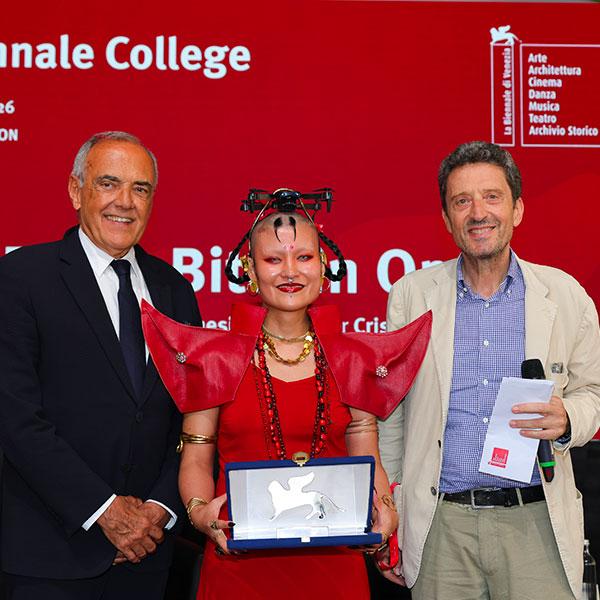
The new March 2026 episode will be available starting on Wednesday, March 25th and will feature contributions from Mamela Nyamza and Sarah Davachi, the Silver Lions of Biennale Danza 2026 and Biennale Musica 2026, and Emma Dante, recipient of the Golden Lion for Lifetime Achievement for Biennale Teatro 2026, Laurie Anderson, American artist and musician invited to the Biennale Arte 2026, Mona Fastvold and Amanda Seyfried, respectively the director and lead of the film The Testament of Ann Lee, presented at the 82nd Venice International Film Festival (see attached report).
The documentary on Rai 5
Willem Dafoe. Autobiografia dell’avanguardia is the documentary that, following the traces of last year’s Biennale Teatro, tells the story of the rise of avant-garde theatre with special attention to what happened in New York starting in the late 1970s, and how, before and beside the film star directed by major filmmakers, there was and is a great interpreter of the finest experimental theatre. The film features interviews with Richard Schechner, leader of The Performance Group, and Elizabeth LeCompte, the head of the Wooster Group.
Willem Dafoe. Autobiografia dell’avanguardia will be broadcast on channel Rai 5 on 28 March at 10:45 pm, and will later be available on RaiPlay. It is a production of Rai Cultura in collaboration with La Biennale di Venezia. Conceived and produced by Felice Cappa, and directed by Dimitri Patrizi, curated by Giulia Morelli, executive producer Serena Semprini, multimedia programmer Matilde Pieraccini.
Catalogues
The official catalogues of the 54th International Theatre Festival, the 20th International Festival of Contemporary Dance and the 70th International Festival of Contemporary Music are published by La Biennale di Venezia and edited by the Directors of the three Departments. The three catalogues will explore the themes, protagonists and productions of each Festival and feature critical essays, images and original illustrations.
The graphic identity of the Dance Music and Theatre Departments is designed by studio Headline in Rovereto, as is the layout of the catalogues for Biennale Danza 2026. The layout of the catalogue for Biennale Musica 2026 and Biennale Teatro 2026 is designed by Studio Tomo Tomo in Milan.
La Biennale di Venezia’s commitment to environmental sustainability
Since 2021, La Biennale di Venezia has launched a plan to review all of its activities in light of recognized and consolidated principles of environmental sustainability. From 2022 to 2024, La Biennale has obtained carbon neutrality certification in accordance with the PAS 2060 standard for all its events held throughout the year, thanks to data collection on the sources of CO₂ emissions generated by the events themselves and the implementation of consequent measures. For the year 2025, the goal was to obtain certification for the calculation of the carbon footprint, in accordance with the new ISO 14067 standard, for all of La Biennale’s scheduled activities. In this sense, La Biennale will engage again in 2026 in a communication campaign to raise the awareness of the participating public (see attached report).
Acknowledgements / Collaborations
Our thanks to the Italian Ministry of Culture for its important contribution and to the Veneto Region for its support of the programmes in the Dance Music and Theatre departments of La Biennale di Venezia.
Media partner of the Dance Music and Theatre departments is once again Rai. Through its information channels and Rai cultura - in particular the TV channel Rai 5 and Radio3 – the various activities taking place in Venice will be described and offered to the public.
Our consolidated collaboration continues with Vela – Venezia Unica, a commercial company of the City of Venice specialized in mobility and marketing, with an agreement of reciprocal promotion and visibility.
We thank the following for their collaboration: Comune di Venezia, Fondazione Forte Marghera, Fondazione Teatro La Fenice, Teatro Stabile del Veneto “Carlo Goldoni”, Fondazione Giorgio Cini, Centro Servizi San Giobbe, and I.P.A.V. Istituzioni Pubbliche di Assistenza Veneziane.