World premiere of the restored digital 4k version carried out by the Centro Sperimentale di Cinematografia in Rome with the support of Netflix.
Cinema -
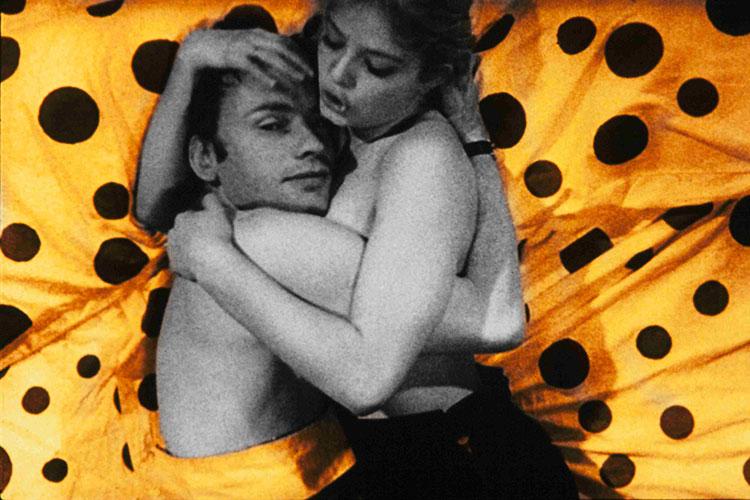
Deadly Sweet (Col cuore in gola, 1967) by Tinto Brass is the pre-opening film of the 83rd Venice Film Festival
Screening on Tuesday 1 September in the Sala Darsena (Lido di Venezia).
Deadly Sweet
In a tribute to the Venetian filmmaker Tinto Brass, the non-conformist genius of Italian cinema, Deadly Sweet (Col cuore in gola, 1967) – the pop thriller he directed and edited, shot in London and starring Jean-Louis Trintignant and Ewa Aulin, with Guido Crepax as graphic consultant – will be the featured film on the Pre-opening night Tuesday 1 September of the 83rd Venice International Film Festival of La Biennale di Venezia, in Sala Darsena on the Lido di Venezia.
Deadly Sweet, which is included in the Venice Classics programme of the 83rd Venice Film Festival (2-12 September) will have its world premiere screening of the restored digital 4k version. The restoration of Deadly Sweet by the CSC-Centro Sperimentale di Cinematografia in Rome with the vital support of Netflix, using materials provided by the holder of rights Compass Film, is a tribute to the master Tinto Brass, a key protagonist of new Italian cinema of the 1960s.
Presented Out of Competition at the 1967 Venice International Film Festival, produced by Ermanno Donati and Luigi Carpentieri, Deadly Sweet is freely inspired by the novel Il sepolcro di carta by Sergio Donati, with screenplay by Tinto Brass, Francesco Longo and Pierre Lévy-Corti, cinematography by Silvano Ippoliti, production design by Carmelo Patrono and music by Armando Trovajoli. Deadly Sweet is one of a group of films shot by the director in the British capital during his London phase, followed by Attraction (Nerosubianco, 1969) and Dropout (1970) and like them, filled with references to pop-art and comic art. As a graphic consultant, Brass enlisted Guido Crepax, then a highly popular cartoonist, to express his vision of pop. “I even had Guido Crepax draw a whole series of illustrations for the action sequences, and they are quite rare because they are one of Crepax’s few works in colour, and in addition to being very beautiful, I used them as a storyboard” (Tinto Brass).
Synopsis (from the pressbook, 1967)
This is the story of a strange brief encounter between a disenchanted man and a girl with no illusions. Strange because it takes place in front of a dead body, brief because it lasts no more than one day and one night. Yet this short interval of time is sufficient to reawaken the rusted mechanism of illusions in him, and in her to kill every feeling other than the purely biological instinct for survival. This is favoured by the objective circumstances in which Jane and Bernard live out their love story: today’s London with its most typical contradictions. Thus the reality that surrounds them bears down with all its fateful weight upon their affair”.
Tinto Brass on Deadly Sweet
“The character I present in the film is a man who falls in love with a girl even when he meets her in front of a corpse. He foregoes any attitude of caution, of expediency and dives headlong into this adventure that totally compromises him. The film is also the story of a disillusionment, given that the character imagines the woman for something she is not”.
“I am speaking of a series of emblematic characters and emblematic settings dominated by the laws of violence and sex, all of which are images from the popular subconscious”.
“The pace of the film is adventurous pace, like that of a thriller, set against the backdrop of London which is absolutely ideal to convey a ‘comic-strip’ reality, which stands in contrast however to the real parts, those that involve the protagonist”.
“The dividing line between reality and the imaginary is fairly clear. All the characters that belong to the imaginary are portrayed as 'objects', seen as pure and simple 'things'. Meaning that they act as creatures of a world that I might describe as expressed in the collages of Rauschenberg or Lichtenstein."
(Statements from an interview with Tinto Brass by the AdnKronos agency, 1967).
Tinto Brass - biographical notes
Born in Milan in 1933 to a Venetian family, after earning a degree in Law, in 1957 Tinto Brass (born Giovanni Brass) moved to Paris where he collaborated in the activities of the Cinémathèque française directed by Henri Langlois, becoming part of the milieu of the emerging Nouvelle Vague and serving as assistant to Joris Ivens and Roberto Rossellini. In 1963, his iconoclastic and irreverent debut as a director, In capo al mondo (later retitled Chi lavora è perduto) was received enthusiastically at the Venice Film Festival. The film came under fire from the censors, and this was the first in a series of battles that Brass fought over time to assert his personal nonconformist libertarian vision. Subsequently, his flair for editing (which he would be responsible for in all his films) emerged in the documentary Thermidor (Ça ira – Il fiume della rivolta, 1965), a hymn to the revolutionary illusions of the 20th century. Following Deadly Sweet (Col cuore in gola, 1967) and several experiences in satirical and western cinema, Brass directed The Howl (L’urlo, 1968, banned in Italy through 1972), a utopian pamphlet that, in the story of a young female protester fleeing the altar, sublimates the libertarian aspirations of the time. In Attraction (Nerosubianco, 1969) and Dropout (1971) he combined the defining trends of Swinging London, while in Vacation (La vacanza, 1971), he extolled the madness of the marginalised. With his two historical-erotic films Salon Kitty (1976) and Caligula (Caligola, made in 1979 and released in 1984, with little resemblance to the original project) and first and foremost The Key (La chiave, 1983), a free adaptation of a novel by Tanizaki Jun’ichirō, Brass inaugurated a new phase, moving in the direction of a culturally-inspired eroticism which was rewarded with great audience acclaim. From The Key onwards, the director focused on the journey of sexual liberation of his female characters.
83rd Festival
The 83rd Venice International Film Festival of La Biennale di Venezia will take place on the Lido from 2 to 12 September 2026, directed by Alberto Barbera.