La Biennale -
The passing of Fabrizio Plessi
A long history with La Biennale di Venezia.
The passing of Fabrizio Plessi
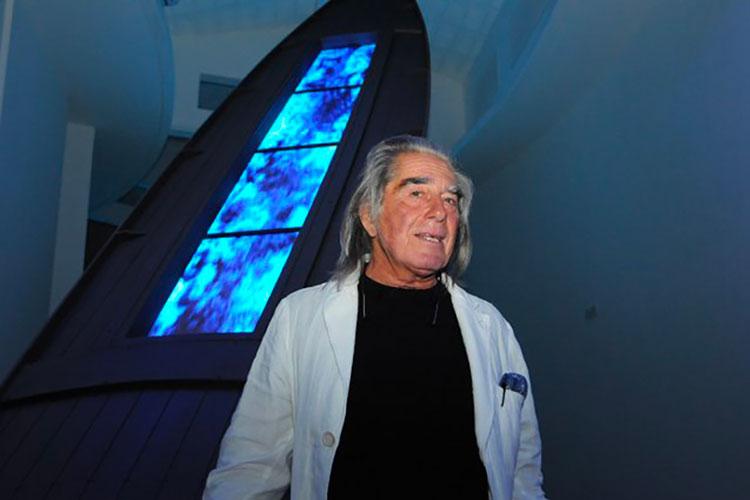
The President, the Board of Directors, the Director General, the Head of the Historical Archive and all of La Biennale di Venezia remember with profound esteem and sincere affection Fabrizio Plessi (Reggio Emilia, 1940 – Dolo, 2026), one of the leading figures in contemporary artistic research in Italy and internationally, who died yesterday at the age of 86.
Fabrizio Plessi's relationship with La Biennale di Venezia runs through a fundamental part of his long and singular artistic career. It is a history closely bound up with the Biennale as a place of experimentation, of openness to new languages and of dialogue between the different forms of artistic research. From his participation in the 35th International Art Exhibition in 1970, within Proposte per una esposizione sperimentale, to his presence at the 42nd International Art Exhibition in 1986 with Bronx, and on to the projects presented at the Biennale in 1972, 1978, 1984 and 2005 and at the 54th International Art Exhibition in 2011 with Mari Verticali, as well as two editions of the International Film Festival in the Officina Veneziana section, in 1981 (Liquid Movie) and 1982 (Underwater), Plessi moved through many different moments in the institution's history. A pioneer of Italian video art, he helped bring the electronic image, television, video and new technologies into the exhibition space, turning them from instruments of representation into the very material of the work.
In 1986, at the 42nd International Art Exhibition of La Biennale di Venezia, Plessi presented Bronx, a work in which television entered the exhibition space as a sculptural and architectural element, anticipating a reflection on the relationship between technology, image and environment that would shape much of his later production.
Formed as an artist in Venice, over more than fifty years Plessi built one of the most original bodies of work in contemporary art. Water, fire, earth, stone and travel were the essential elements of a poetics in which matter and image, nature and technology, memory and movement continually met.
His research on water, begun in the late 1960s, found an early and important formulation in Acquabiografico (1973), while works and actions such as Taglio del lago, Camminare sull'acqua and Operazione il Taglio del fiume Schelde marked the passage from the physical experience of landscape to its transformation through photography and video. With A morte Venezia (1976), Liquid Movie and Underwater, the natural element entered ever more deeply into the electronic image, in a body of work in which video progressively ceased to be document and became space, body and matter.
After Bronx, the international dimension of his research was confirmed by Roma at Documenta 8 in Kassel in 1987. In the years that followed, Plessi continued to move beyond the traditional boundaries of the visual arts, weaving his work together with theatre, dance, music and architecture. His collaborations with Frédéric Flamand, Michael Nyman, Aterballetto and the theatre are well known, as are the electronic sets he created for Luciano Pavarotti's concert in Central Park, New York, in 1993.
His large-scale installations have inhabited museums, squares, historic buildings and landscapes, making place not a mere container but an essential component of the work. From Mare Verticale for Expo 2000 in Hanover to Waterfire in Venice, from Memory Motions at the Kistefos-Museet to the many projects realised in recent years, Plessi continued to transform natural elements into luminous images in movement, always keeping the relationship between matter and technology at the heart of his research.
In his most recent works, too, water remained an originary presence: from L'Età dell'Oro, created in 2020 on the windows of the Museo Correr overlooking Piazza San Marco, to Mari Verticali in the Sala delle Cariatidi of Palazzo Reale in Milan, and on to the immersive projects conceived in dialogue with places of history and archaeology.
With his passing, La Biennale di Venezia loses an artist who accompanied and, in many moments, anticipated the transformations of contemporary language. His work brought the ancestral force of the elements into dialogue with the immaterial dimension of technology, restoring to the electronic image a surprising physicality, and to matter a new possibility of movement, light and memory.
Fabrizio Plessi's long history with La Biennale di Venezia thus remains a significant part of the history of the institution and of artistic research: a history that spans more than fifty years without ever losing its visionary force. One testimony to this long relationship is preserved in the Historical Archives of the Biennale, to which the artist himself wished to send copies of 60 catalogues of his work.
La Biennale di Venezia extends its most heartfelt sympathy to his family and to all those who were close to him.